

When managing bulk coal storage in power plants, cement factories, ports, and chemical enterprises, thermal management inside enclosed storage silos is a top operational priority. The spontaneous combustion of stored coal poses continuous threats of smoldering fires and catastrophic dust explosions.
Deploying an industrial-grade coal silo temperature cable system is mandatory for early self-heating detection. However, choosing the right monitoring cable requires an understanding of hazardous area certifications, high-tension mechanical resistance, and electronic reliability.
This comprehensive technical guide breaks down the essential explosion-proof requirements, selection metrics, and engineering specifications for coal silo temperature cables-highlighting advanced design benchmarks like the ZS-11 (PRO) Multi-Point Temperature Monitoring Cable.

1. Explosion-Proof Standards & Hazardous Zone Compliance
Coal silos can present a dual-hazard environment involving combustible coal dust and potentially hazardous gas accumulation, including methane (CH4) and carbon monoxide (CO).
Temperature sensing equipment installed inside the silo should therefore be selected according to the actual hazardous-area classification and applicable local certification requirements, such as ATEX, IECEx, or relevant GB standards.
Combustible Dust Protection: Ex iaD 20 T85°C
Zone 20 Certification
For installations classified as Zone 20, temperature monitoring equipment must be suitable for areas where combustible dust clouds may be present continuously, frequently, or for extended periods.
Thermal Surface Control
A T85°C temperature marking indicates that the specified maximum surface temperature of the equipment is limited to 85°C under the conditions defined by the applicable certification standard.
This is particularly important in coal storage applications where excessive surface temperatures could increase ignition risks.
Intrinsically Safe Gas Protection: Ex ia IIC T6 Ga / Ex ib IIB T6 Gb
Ga / Zone 0 Capability
Ex ia IIC T6 Ga represents a high level of intrinsic safety protection for gas hazardous areas.
Intrinsic safety systems limit the electrical and thermal energy entering the hazardous area so that ignition of the specified explosive atmosphere is prevented under defined normal and fault conditions.
Temperature Class T6
T6 equipment has a maximum permitted surface temperature of 85°C under the applicable certification conditions.
This provides an additional safety margin for installations involving potentially flammable gases.
Ingress Protection Rating: IP68
Coal silos may contain high levels of dust, moisture, condensation, and occasional water exposure.
For demanding environments, temperature sensor cables with an IP68-rated sealed structure can provide increased resistance to water and dust ingress.
Premium cable designs may use fully sealed internal structures and silicone potting to protect sensing elements and internal electrical connections.
2. Key Selection Parameters for Coal Silo Temperature Cables
When selecting a multi-point temperature sensor cable for deep coal silos, mechanical durability is just as important as electrical accuracy.
During coal filling and discharge, significant downward and lateral forces can be applied to vertically suspended cables.
Standard unarmored or lightly reinforced sensor cables may be damaged by these forces.
Technical Specification Comparison & Selection Metrics
| Selection Metric | Industry Baseline | ZS-11 (PRO) Benchmark Specification | Engineering Advantage & Rationale |
|---|---|---|---|
| Tensile Resistance | ≥50 kN, approximately 5 Tons | >18 Tons / >180 kN | Double-Layer Armor: 69 high-strength steel wires arranged in counter-wound layers help distribute mechanical loads and improve resistance to tensile forces. |
| Outer Diameter (OD) | 30–45 mm | ≤26.5 mm | Reduced Drag: A relatively compact cable diameter reduces contact area with bulk coal and can help reduce resistance during filling and discharge. |
| Crush Protection | Plastic conduit or basic reinforcement | Flexible Metal Inner Tube | Structural Protection: An internal metal support tube protects sensing components and internal conductors from lateral pressure and crushing forces. |
| Operating Temperature | -20°C to +80°C | -40°C to +120°C | Wide Operating Range: Suitable for low-temperature outdoor environments while providing sufficient thermal margin for detecting abnormal coal heating. |
| Internal Wire Insulation | PVC / PE | High-Temperature PTFE Insulation, up to 270°C material rating | Thermal Stability: PTFE insulation provides excellent heat resistance and reduces the risk of conductor insulation softening or short-circuiting in localized hot areas. |
| Sensing Technology | Thermocouple / Pt100 / digital sensor | Digital Bus, ZS18B20D / DS18B20 | Digital Transmission: Digital sensing helps reduce analog signal degradation over long cable runs and provides stable multi-point temperature acquisition. |
| Temperature Accuracy | Application dependent | ±0.5°C | Provides reliable temperature monitoring for early detection of abnormal heating trends. |
| Sensors Per Cable | 5–20 points | Up to 100 points per cable | High-Density Profiling: Multiple temperature sensing points can be distributed vertically through the coal mass. |
| Cable Length | Application dependent | 5–40 m | Suitable for a wide range of coal silos and storage structures. |
| Sensor Spacing | Application dependent | Typically 1–3 m, customizable | Allows the monitoring density to be adapted according to silo height, coal properties, and engineering requirements. |
| Electrostatic Protection | Basic ESD protection | ESD ≥8000 V | Static Immunity: Enhanced electrostatic protection helps improve sensor reliability in dry environments where friction between coal particles may generate static electricity. |
| Maintainability | Non-replaceable structure | Extractable / Replaceable Inner Core | Lower Maintenance Cost: The sensing core can be removed and replaced without replacing the entire heavy-duty outer armored cable assembly. |
| Ingress Protection | IP65 / IP67 typical | IP68 | Provides enhanced resistance to coal dust, moisture, condensation, and water ingress. |
3. Silo Layout & Cable Quantity Calculation Standards
Determining the correct number of coal silo temperature monitoring cables depends primarily on silo diameter, silo height, coal characteristics, monitoring objectives, and the required sensing density.
Coal has relatively low thermal conductivity. A localized hot spot may therefore develop without producing an immediate temperature increase several meters away.
For this reason, relying on only one temperature cable in a large-diameter coal silo may leave significant monitoring blind spots.
A distributed multi-cable arrangement can provide more complete spatial temperature coverage.
Recommended Cable Quantity Matrix by Silo Diameter
Silos ≤6 m Diameter
- Recommended quantity: 1 cable
- Typical arrangement:
- 1 center temperature cable
Silos 8–10 m Diameter
- Recommended quantity: 3 cables
- Typical arrangement:
- 3 cables distributed around the inner monitoring area
- Typical installation radius: approximately 2.3–2.5 m
Silos 12 m Diameter
- Recommended quantity: 4 cables
- Typical arrangement:
- 1 center cable
- 3 surrounding cables
- Typical ring radius: approximately 3.3 m
Silos 14–18 m Diameter
- Recommended quantity: 6–8 cables
- Typical arrangement:
- 1 center cable
- 5–7 surrounding cables
Silos 20–24 m Diameter
- Recommended quantity: 11–13 cables
- Typical arrangement:
- Center monitoring point
- Multiple cables arranged in two concentric monitoring rings
Silos 26–28 m Diameter
- Recommended quantity: 17–19 cables
- Typical arrangement:
- 1 center cable
- Approximately 6 cables on the first monitoring ring
- Approximately 10–12 cables on the second monitoring ring
Silos 30 m Diameter
- Recommended quantity: approximately 22 cables
- Example arrangement:
- 3 cables on the first monitoring ring
- 7 cables on the second monitoring ring
- 12 cables on the third monitoring ring
Silos 36–40 m Diameter
- Recommended quantity: approximately 29–34 cables
- Typical arrangement:
- Multiple concentric monitoring rings
- Monitoring radius extending according to the actual silo diameter and engineering design
These quantities should be considered preliminary engineering recommendations rather than universal mandatory values.
The final arrangement should be determined according to silo geometry, coal filling height, discharge pattern, sensor spacing, local safety requirements, and project risk assessment.
4. Mechanical Mounting & System Architecture
Proper mechanical installation is essential for preventing cable damage and ensuring stable long-term temperature monitoring.
The support structure must withstand both:
- The static weight of the cable
- Additional mechanical forces generated by moving coal

Flange Installation
A heavy-duty mounting flange can be installed over an opening in the silo roof.
A typical system may use:
Carbon-steel mounting flange
Approximately 160 mm outer diameter
Approximately 14.2 mm thickness
Installation over approximately 55–80 mm roof openings
The exact flange dimensions and load rating should be selected according to the structural design of the project.
For ZS-11 (PRO) installations, the mounting assembly should be designed to match the cable's heavy-duty tensile capacity.

Suspension U-Bolt Installation
Heavy-duty galvanized U-bolts or engineered suspension brackets can also be used when structural beams or suitable anchor points are available above the silo.
The suspension hardware must have a sufficient safety factor relative to the maximum expected cable loading.
5. Bottom Alignment and Cable Movement
The lower end of the cable may use a heavy end weight to help maintain vertical alignment during installation and operation.
However, the bottom of a temperature monitoring cable should generally be allowed to accommodate movement caused by coal filling and discharge.
Where project conditions require bottom restraint, the mechanical design should account for lateral coal movement and avoid transferring excessive load directly into the sensing cable.
Important Installation Note:
Rigidly fixing both ends without considering bulk-material movement may result in excessive tension, deformation, or mechanical damage.
6. Control System Integration
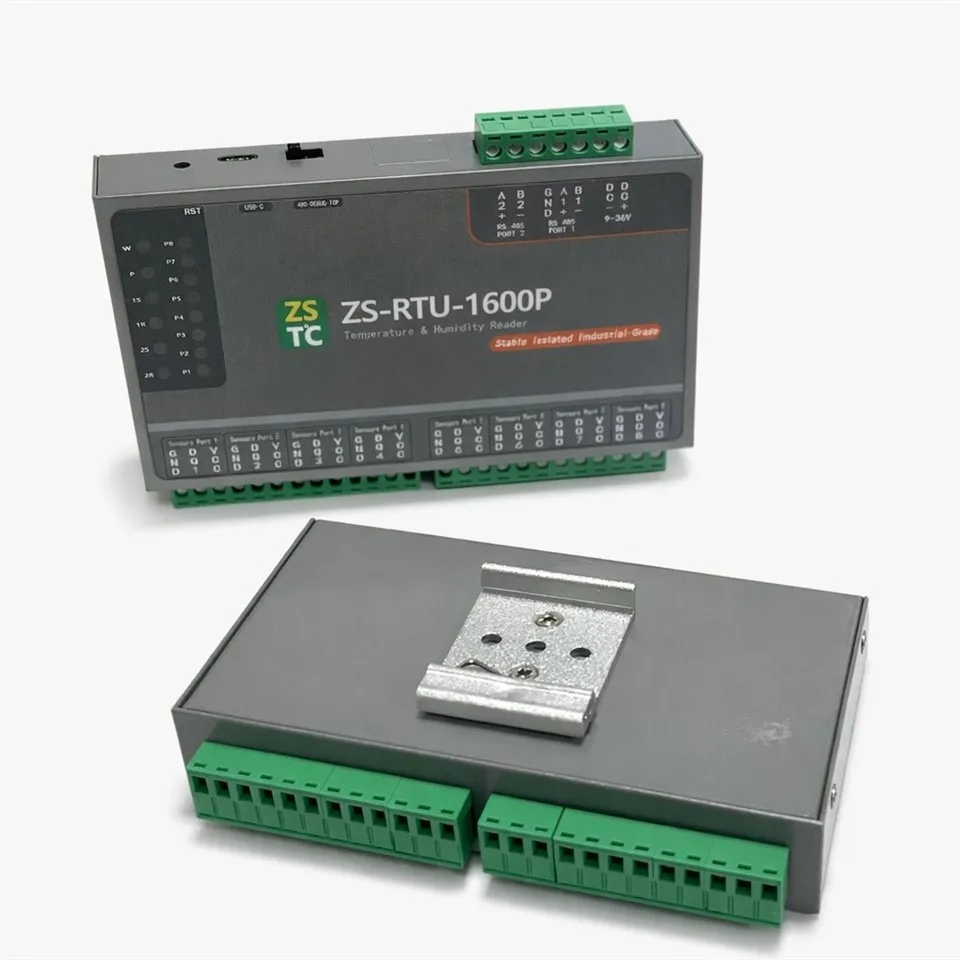
Coal silo temperature cables are typically connected to a multi-channel temperature data collector.
For example, the ZS-RTU-1600P Multi-Point Temperature Collector can acquire temperature data from multiple sensor cables and transmit the collected information to the plant automation system.
6.1 Typical Communication Methods
Supported or commonly used interfaces may include:
- RS485
- Modbus-RTU
- Modbus-TCP
- PLC integration
- DCS integration
- SCADA integration
- Local HMI monitoring
- Remote industrial monitoring platforms
6.2 Typical System Architecture
Multi-Point Temperature Sensor Cable → Temperature Collector → RS485 / Ethernet → PLC / DCS / SCADA
This architecture allows operators to:
- Monitor individual sensor points
- Analyze temperature trends
- Compare temperature zones
- Detect abnormal heating
- Identify sensor failures
- Integrate alarms into plant control systems
7. Field Communication Cable Recommendations
For communication between field temperature collectors and control equipment, twisted-pair shielded communication cables are commonly recommended.
Depending on system distance and installation environment, suitable options may include:
- Industrial RS485 shielded twisted pair
- CAT5e
- CAT6
- Other industrial communication cables approved for the project
The following parameters should be selected according to the collector manufacturer's communication requirements:
- Cable type
- Conductor size
- Shielding
- Grounding
- Termination resistance
- Maximum transmission distance
In electrically noisy industrial environments, proper shielding and grounding are especially important for maintaining stable Modbus communication.
8. Why Multi-Point Temperature Monitoring Is Important in Coal Silos

Coal self-heating often begins locally.
Oxidation reactions inside a coal mass generate heat. If this heat cannot dissipate effectively, the local temperature may gradually increase.
Because coal is a relatively poor thermal conductor, a dangerous hot spot can develop while nearby locations remain at apparently normal temperatures.
This means that a single temperature sensor cannot adequately represent the thermal condition of a large coal silo.
A multi-point temperature monitoring cable places multiple sensors vertically through the stored material.
When several cables are distributed horizontally across the silo, the monitoring system forms a three-dimensional temperature sensing network.
Conclusion
A reliable coal silo temperature cable is more than a series of temperature sensors installed inside a steel cable.
For demanding coal storage applications, the complete system must combine:
- Mechanical strength
- Environmental sealing
- Electrical reliability
- Temperature accuracy
- Maintainability
- Industrial communication compatibility
For large coal silos, engineers should pay particular attention to tensile strength, cable distribution density, sensor spacing, explosion-protection requirements, and long-term maintainability.
The ZS-11 (PRO) Multi-Point Temperature Monitoring Cable is designed for demanding bulk coal storage applications, combining heavy-duty mechanical armor, multi-point digital temperature sensing, IP68 protection, a replaceable internal sensing core, and compatibility with industrial RS485 and Modbus monitoring systems.
By designing the temperature monitoring network according to actual silo dimensions and operational conditions, plant operators can obtain a more complete temperature profile and identify abnormal coal heating at an earlier stage.