

1. How Long Can Grain Be Stored?
Grain can be stored for months or even years, depending on the type of grain, its initial quality, moisture content, temperature, and storage conditions. However, there is no single storage period that applies to every grain or storage facility.
Rice, wheat, corn, and soybeans respond differently to storage conditions. Even the same type of grain may have a significantly different storage life depending on how well it is dried, cooled, and monitored.
For long-term grain storage, three factors are particularly important:
Moisture content
Excessive moisture increases the risk of mold growth, heating, and quality deterioration.
Temperature
Warm grain generally deteriorates faster and can support greater insect and microbial activity.
standardized production
Efficient and precise processing and testing equipment.
The goal is not simply to keep grain in storage for as long as possible. It is to maintain grain quality throughout the storage period.
2. What Affects Grain Storage Life?
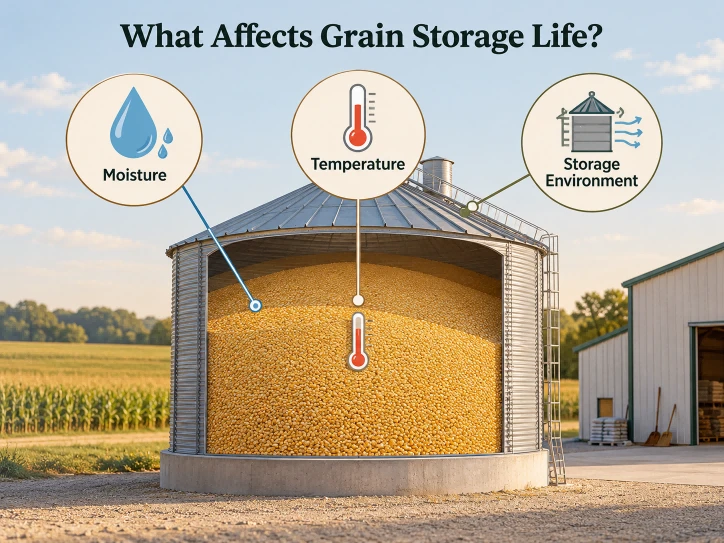
Grain Moisture Content
Moisture content is one of the most important factors in determining how long grain can be stored safely.
Grain harvested with excessive moisture should be dried to a suitable level before long-term storage. Moist grain is more susceptible to deterioration, particularly when temperatures are high.
Moisture requirements vary by crop, climate, intended storage duration, and applicable storage standards. For this reason, grain moisture should be measured rather than estimated from the surrounding air humidity alone.
Grain Temperature
Temperature has a direct influence on biological activity and grain deterioration. Warm conditions can encourage insect activity and microbial growth, especially when moisture levels are also high.
Temperature differences inside a grain silo can also cause moisture migration and condensation. These conditions may create localized hot spots, even when the average temperature of the grain bulk appears normal.
Regular temperature measurements at multiple locations help operators identify unusual changes and investigate potential storage problems.
Storage Environment
The design and condition of the storage facility also affect grain quality.
A well-managed facility should help prevent water intrusion, reduce moisture fluctuations, control pests, and support appropriate aeration. Grain should be inspected regularly for signs of heating, condensation, mold, insects, or unusual odors.
Good storage management combines suitable initial grain conditions with continuous monitoring and timely intervention.
3. Why Different Grains Have Different Storage Requirements
Different grain types have different physical characteristics, moisture requirements, and intended uses. Storage plans should therefore be adapted to the grain being stored.
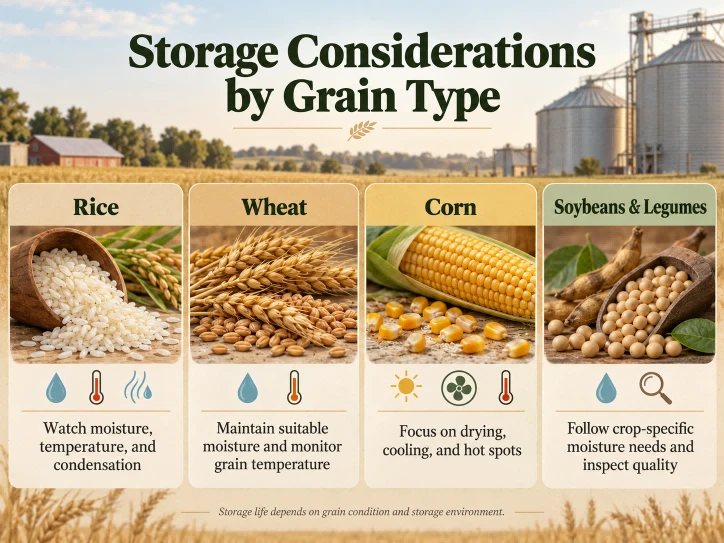
| Grain type | Important storage considerations |
|---|---|
| Rice | Control moisture and temperature; watch for condensation and changes in grain quality. |
| Wheat | Maintain suitable moisture levels and monitor temperature changes throughout the grain bulk. |
| Corn | Pay particular attention to initial moisture, drying, cooling, and localized heating. |
| Soybeans and other legumes | Follow crop-specific moisture requirements and inspect for insects and quality deterioration. |
These are general management considerations rather than fixed storage-life guarantees. The actual storage period depends on the condition of the grain and the environmental conditions throughout storage.
For long-term storage, operators should follow applicable grain storage standards and crop-specific recommendations rather than relying on a universal number of years.
4. Why Grain Temperature Monitoring Matters
Grain deterioration does not always begin with visible mold or an obvious change in appearance. Temperature changes inside a grain bulk may provide an early indication that further inspection is needed.
Traditional manual measurements can help operators check selected locations, but they may not provide enough information about large warehouses or deep silos.
A multi-point grain temperature monitoring system addresses this limitation by measuring temperature at different depths and locations inside the grain.
Key benefits include:
industry-leading
Five years of electronic mechanical products precipitation,products mature and stable
01
High market share
Benchmarking machinery has great influence,covering 1,500 companies and 15 well-known enterprises across the country
02
High market share
Benchmarking machinery has great influence,covering 1,500 companies and 15 well-known enterprises across the country
03
Perfect product system
Electronic + technology solutions,complete product architecture system
04
Efficient after-sales service
To provide customers with a range of product services,24 hours online
05
Temperature monitoring does not replace moisture testing, pest inspection, or proper grain handling. Instead, it provides an important source of information for a more complete grain storage management strategy.
5. How to Design an Effective Grain Monitoring System
A reliable grain monitoring system should be designed around the storage facility, the grain being stored, and the required monitoring coverage.
why choose us
Lorem ipsum dolor sit amet consectetur adipisicing elit.
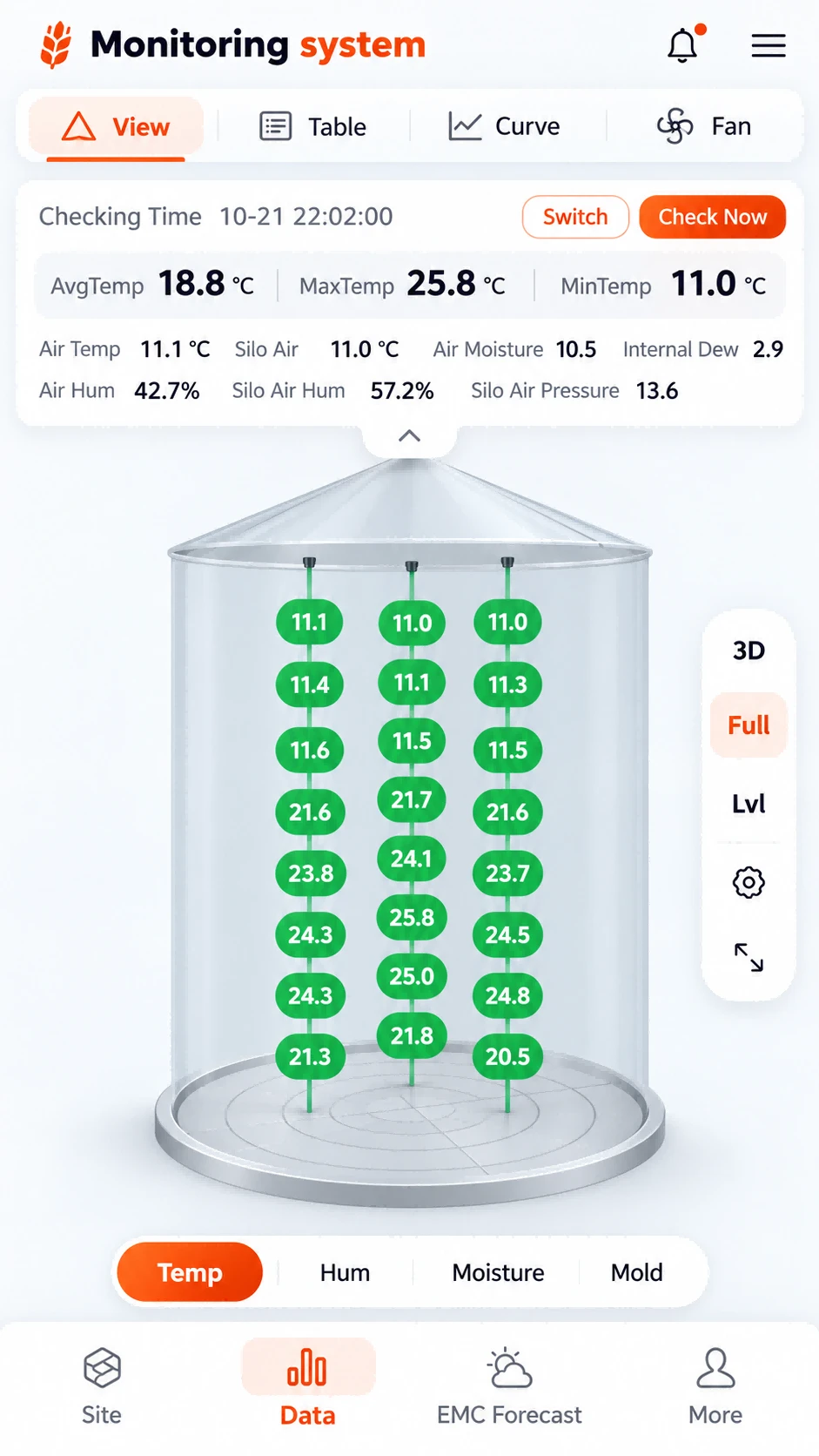
1.Multi-Point Temperature Sensor Cables
Multi-point sensor cables are installed inside the grain bulk to measure temperature at multiple positions along each cable.
By placing sensor cables at appropriate locations, operators can compare conditions across different parts of a warehouse or silo and identify localized temperature changes that might otherwise go unnoticed.
Learn more about our multi-point grain temperature sensor cables.
2.Temperature and Humidity Monitoring
Temperature data provides valuable information about grain conditions. Where the application requires humidity monitoring, compatible humidity sensors can provide additional information about the storage environment.
It is important to distinguish relative humidity from grain moisture content. Relative humidity measurements are useful for assessing environmental conditions, but they do not directly replace grain moisture testing.
Combining appropriate sensors with regular grain inspections gives operators a more complete view of storage conditions.
3.Data Acquisition and Remote Monitoring
In large grain storage facilities, collecting data from multiple sensor cables requires a reliable acquisition and communication system.
An industrial data acquisition unit can collect sensor readings and transmit them to compatible monitoring software or control systems. This allows operators to review data from multiple locations without checking every sensor manually.
The ZS-RTU-800P data acquisition unit supports multi-point grain monitoring applications, with capacity for up to 800 sensor points and MODBUS-RTU/MODBUS-TCP communication.
For larger installations, the ZS-RTU series multi-point acquisition solutions provide additional options for system design and integration.
6. Best Practices for Long-Term Grain Storage
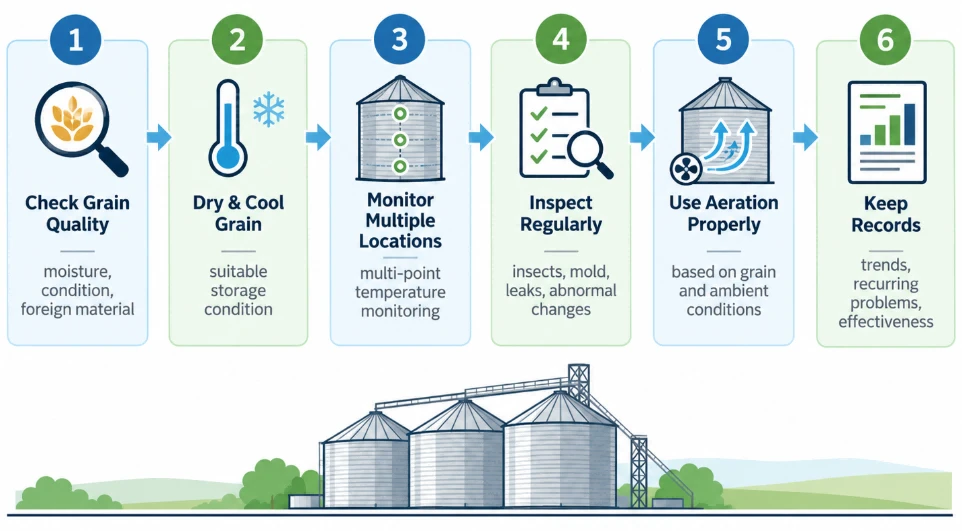
A practical grain storage management plan should include the following steps:
1. Check grain quality before storage.
Measure moisture content, inspect grain condition, and remove excessive foreign material where appropriate.
2. Dry and cool grain as required.
Follow crop-specific recommendations to establish suitable conditions for the intended storage period.
3. Monitor temperature at multiple locations.
Use a suitable monitoring arrangement to identify localized heating and temperature differences throughout the grain bulk.
4. Inspect grain and storage facilities regularly.
Check for insects, mold, condensation, leaks, and unusual temperature changes. Investigate abnormal readings rather than relying solely on average temperatures.
5. Use aeration appropriately.
Aeration should be planned according to grain temperature, moisture, and ambient conditions. Poorly timed aeration can introduce unwanted moisture or create condensation.
6. Keep monitoring records.
Historical data helps operators compare temperature trends, identify recurring problems, and evaluate the effectiveness of storage management measures.