

1. World Food Day: Innovation for a Food-Secure Future
World Food Day, observed annually on October 16, highlights the importance of food security, sustainable agriculture, and reducing food loss throughout the agricultural supply chain.
Food security depends on more than producing enough crops. It also requires effective harvesting, transportation, storage, and distribution. As agriculture faces increasing challenges from extreme weather, limited natural resources, and growing food demand, protecting harvested grain has become an essential part of ensuring a reliable food supply.
Smart grain storage technology and advanced monitoring systems are helping the grain industry adopt more efficient, accurate, and data-driven management practices.
Reliable grain temperature monitoring, scientific storage management, and intelligent data acquisition help storage operators identify abnormal conditions, reduce avoidable grain losses, and maintain grain quality.

2. Food Security Begins with Proper Grain Storage
Grain production is only the first step in the food supply chain. After harvesting, grain must be stored under suitable conditions to preserve its quality and minimize losses.
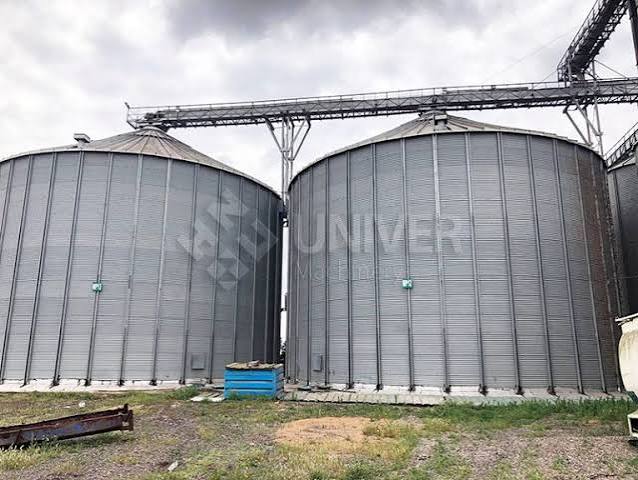
Poor storage conditions can expose grain to excessive temperatures, moisture migration, condensation, insect activity, and mold growth. These problems can reduce grain quality, affect its market value, and increase economic losses.
Large grain silos and warehouses present additional challenges because temperature and moisture conditions may vary across different locations and depths within the stored grain. A single measurement point may not accurately represent the condition of the entire grain mass.
Effective grain storage management should therefore focus on several key areas:
Grain temperature monitoring:
Detect abnormal temperature increases that may indicate developing storage problems.
01
Moisture management:
Evaluate grain moisture and storage humidity, where applicable, to help manage condensation and deterioration risks.
02
Early warning:
Identify abnormal temperature trends that require further inspection.
03
Storage management:
Use monitoring data to support ventilation decisions, inspections, and other storage operations.
04
By combining reliable monitoring equipment with appropriate storage practices, grain operators can improve their understanding of storage conditions and better protect stored grain.
3. Smart Grain Storage: Protecting Every Grain Through Technology
Digital technology is transforming traditional grain storage into a more intelligent and data-driven process. Modern monitoring systems enable operators to move beyond occasional manual measurements and gain continuous visibility into storage conditions.
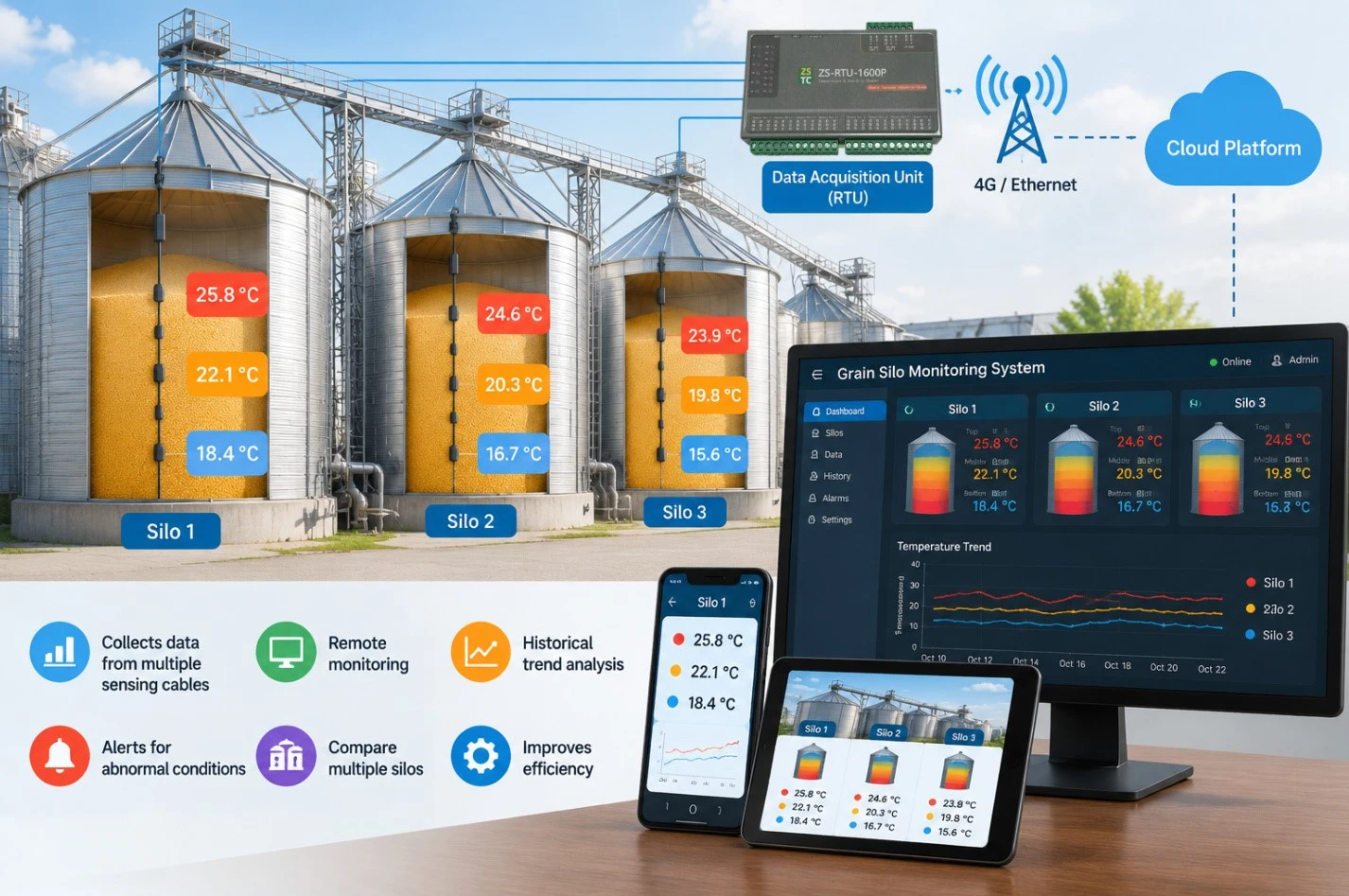
A typical grain temperature monitoring system consists of multi-point temperature sensing cables, data acquisition units, communication networks, and monitoring software.
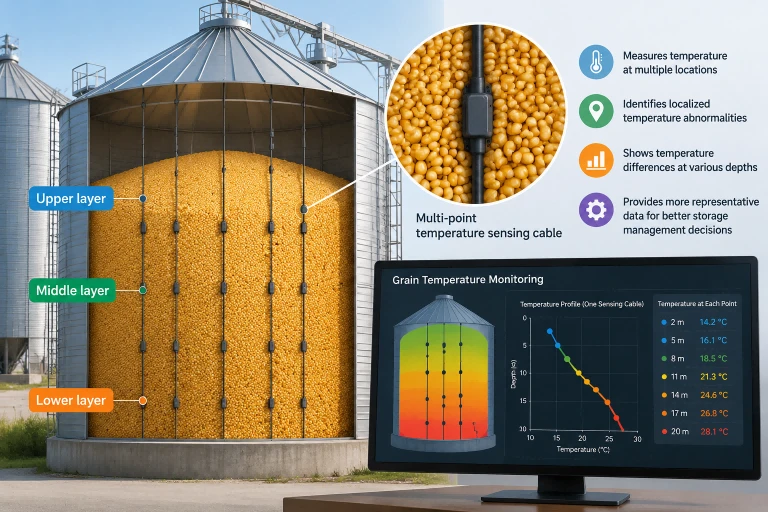
Multi-Point Grain Temperature Monitoring
Multi-point temperature sensing cables are installed inside grain silos or warehouses to measure temperatures at multiple locations within the grain mass.
Compared with single-point measurements, multi-point monitoring provides a more comprehensive picture of temperature distribution. It helps operators identify localized temperature abnormalities and differences between various depths of stored grain.
This approach is particularly valuable for large grain silos, where conditions in the upper, middle, and lower sections may differ significantly.
With an appropriate sensor layout, operators can obtain more representative monitoring data and make better-informed storage management decisions.
Intelligent Data Acquisition and Remote Monitoring
A grain temperature monitoring system can collect readings from multiple sensing cables and transmit the data to a central monitoring platform.
Depending on the system configuration, operators can remotely review temperature readings, compare conditions across different silos, analyze historical trends, and receive alerts when predefined conditions are met.
These capabilities help reduce repetitive manual measurements, improve operational efficiency, and enable faster responses to abnormal conditions.
For facilities managing multiple silos or large grain storage warehouses, centralized monitoring also simplifies daily supervision and cross-silo data comparison.
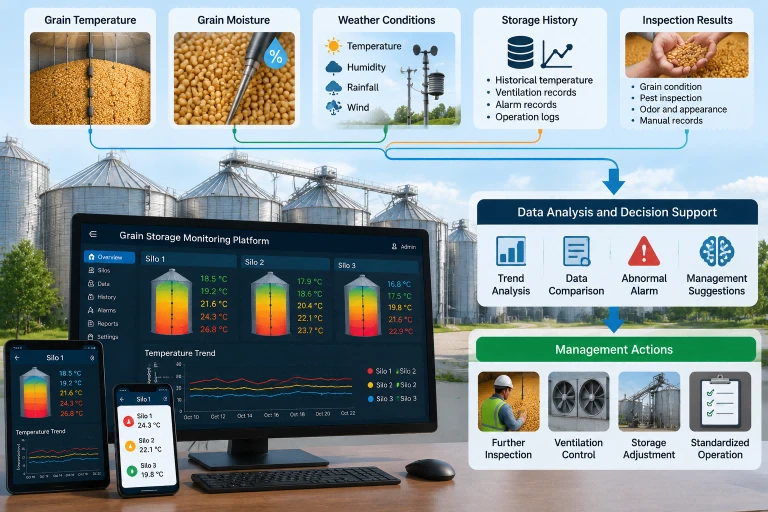
Data-Driven Grain Storage Management
Continuous temperature monitoring helps operators understand how grain temperatures change over time.
When combined with grain moisture measurements, weather conditions, storage history, and inspection results, temperature data can support decisions about further inspections, ventilation, and other appropriate management actions.
By integrating real-time monitoring, historical data analysis, and standardized operating procedures, grain storage facilities can adopt a more systematic approach to storage management.
4. Reducing Post-Harvest Losses Through Grain Temperature Monitoring
Post-harvest losses remain a significant challenge throughout agricultural supply chains. If unfavorable storage conditions are not identified promptly, grain quality may deteriorate, resulting in avoidable losses.
Grain temperature monitoring is an important tool for managing these risks.
An abnormal temperature increase in a particular area of stored grain may indicate a condition that requires investigation, such as biological activity, moisture-related changes, or another storage issue. Early detection gives operators an opportunity to inspect the affected area and take appropriate action.
However, an elevated temperature reading does not automatically confirm mold growth or insect infestation. Effective assessment should consider temperature trends, grain moisture, grain characteristics, and other relevant observations.
A well-designed grain monitoring system can help storage operators:
Detect abnormal temperature changes earlier
Identify potential hotspots within stored grain
Improve the efficiency of storage inspections
Support informed aeration and storage management decisions
Reduce avoidable grain deterioration and associated economic losses
The effectiveness of these measures depends on appropriate sensor placement, reliable equipment, suitable alarm settings, and consistent operating procedures.
Reducing grain losses is not only about producing more food. It is also about protecting the food that has already been harvested.
5. Building Efficient and Reliable Grain Storage Systems
As grain storage facilities increase in scale, sufficient storage capacity alone is no longer enough. Modern facilities also need reliable monitoring data, coordinated equipment, and standardized management procedures.
Automation is increasingly used to improve grain intake, quality inspection, handling, and storage operations.
For example, intelligent grain inspection systems can streamline sampling and quality assessment during grain intake. Automated conveying and handling equipment can improve loading and unloading efficiency. Meanwhile, grain temperature monitoring networks provide continuous information about temperature conditions inside silos.
When these technologies work together, they improve visibility across multiple stages of grain storage operations.
Several factors should be considered when designing a grain monitoring system
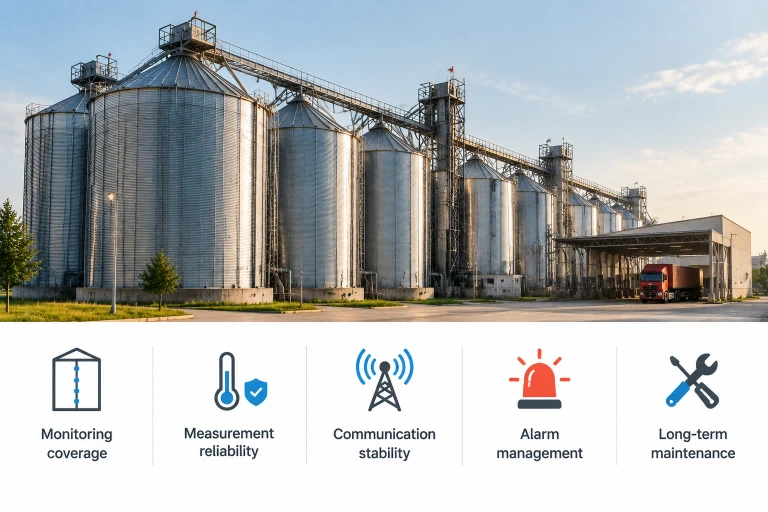
01.Monitoring coverage
02.Measurement reliability
03.Communication stability
04.Alarm management
05.Long-term maintenance
6. Smart Grain Storage Solutions for Better Food Security
Food security requires coordinated efforts throughout the agricultural supply chain. Farmers, grain traders, storage operators, equipment manufacturers, and policymakers all play important roles in maintaining a reliable food supply.
Agricultural innovation can improve crop production, while effective post-harvest management helps preserve the value of that production.
For grain storage operators, investing in appropriate monitoring and management technologies can contribute to:
- Better protection of stored grain quality.
- More efficient storage inspections.
- Improved visibility into silo conditions.
- Earlier identification of potential storage risks.
- Better-informed operational decisions.
- Reduced avoidable post-harvest losses.
The most suitable solution depends on facility size, grain type, local climate, and operational requirements.
For large grain silos, multi-point temperature sensing cables combined with centralized data acquisition systems can provide valuable information across multiple storage locations. For flat warehouses and other storage facilities, monitoring arrangements can be adapted to the building layout and storage method.
Regardless of the facility type, the objective remains the same: monitor storage conditions, identify potential problems early, and protect grain quality throughout the storage period.
About Zhaosui Temperature Cable
Langfang Zhaosui Temperature Cable Co., Ltd. specializes in grain temperature monitoring cables, temperature and humidity sensing cables, and grain storage monitoring equipment. We provide customized monitoring solutions for grain silos, warehouses, and other storage facilities.
Our products help storage operators monitor grain conditions, identify temperature abnormalities, and improve daily storage management.
Learn more about our company and explore our solutions:
About Us - Learn about our company and manufacturing capabilities.
Grain Temperature Monitoring Systems - Explore monitoring solutions for grain storage facilities.
Grain Temperature and Moisture Cables - Discover multi-point sensing solutions for grain storage.
Looking for a grain temperature monitoring solution for your facility? Contact our team to discuss your project requirements and customized options.