

1. Introduction: The Evolution of Grain Temperature Monitoring

Grain temperature monitoring has been a cornerstone of grain storage management for decades. Traditionally, manual temperature measurement was the primary method used in grain storage facilities. Operators relied on handheld probes or fixed inspection points to assess temperature levels at various locations within the grain bulk.
However, as storage systems have grown larger, more complex, and more data-driven, manual measurement has proven to be insufficient for modern needs. The transition from manual to automated temperature monitoring systems reflects the increasing scale and complexity of grain storage operations.
To understand why grain temperature is such a critical indicator of grain condition, you can refer to the first subcluster article:
🔗 Understanding Grain Temperature: Why It Is the Most Critical Indicator of Grain Condition
For a broader perspective on how different warehouse structures influence temperature behavior and monitoring challenges, see the second subcluster article:
🔗 Warehouse Types and the Challenges of Grain Temperature Monitoring
Both of these articles link into the comprehensive overview presented in the core article:
👉 Grain Temperature Monitoring: The Cornerstone of Safe, Efficient, and Modern Grain Storage
2. Manual Temperature Measurement: Traditional but Limited
2.1 How Manual Temperature Measurement Works
Manual temperature measurement involves the use of handheld probes or fixed thermometers to take temperature readings at specific points within the grain bulk. These devices are inserted into the grain mass at selected locations, either along the surface or at predetermined depths, to capture temperature data.
This method has been widely used in grain storage operations for many years, especially in smaller facilities with limited storage depth.
2.2 Limitations of Manual Temperature Measurement
Despite its long history of use, manual measurement presents several disadvantages:
Limited Coverage:
Manual probes typically measure temperature at only a few points within the grain bulk. This means that large areas-especially deep or central zones-may remain unmonitored. Consequently, early-stage anomalies can go undetected.
01
Subjectivity and Inconsistency:
Human operators may vary in probe insertion depth, duration of measurement, and interpretation of results. These inconsistencies can lead to unreliable data.
02
Labor-Intensive Work:
Taking multiple manual readings across a large facility requires significant time and effort, making this method inefficient for modern, high-capacity storage.
03
Delayed Detection:
Manual inspections are periodic rather than continuous, meaning significant changes can occur between readings and only be detected after the fact.
04
Given these limitations, manual measurement is increasingly used as a supplementary tool - one that is best deployed in coordination with automated monitoring for comprehensive insight.
3. Automated Temperature Monitoring Systems
3.1 What Is an Automated Monitoring System?
Automated temperature monitoring systems offer continuous, real-time tracking of grain temperature throughout the storage area. These systems consist of a network of sensors installed at various depths and positions within the grain bulk. The sensors send data to a central system, which aggregates, analyzes, and displays temperature trends.
Unlike manual methods, which only provide isolated readings, automated systems deliver dynamic insights into internal conditions.

3.2 Core Components of Automated Systems
Key components of a modern automated temperature monitoring system include:
Multi‑point Temperature Sensors
These are positioned at strategic depths and locations to ensure comprehensive coverage across the grain mass.
Data Acquisition Units (DAUs)
DAUs collect sensor readings and transmit them to the central monitoring system.
Central Monitoring Software
This platform visualizes real-time temperature data, stores historical records, and enables dashboard views of key metrics.
One-stop Solution
Intelligent alerts notify operators when temperature thresholds are exceeded, supporting preventive action.
3.3 Advantages of Automated Systems
Automated systems introduce clear advantages:
Continuous Real‑Time Monitoring:
Enables immediate detection of abnormal temperature behavior.
Comprehensive Coverage:
Ensures all critical zones - including deep layers - are monitored.
Reduced Human Error:
Eliminates inconsistency associated with manual probe readings.
Long‑Term Trend Analysis:
Historical data can be analyzed to support operational planning and predictive modeling.
4. Comparing Manual and Automated Temperature Monitoring
| Comparison Aspect | Manual Temperature Monitoring | Automated Temperature Monitoring |
|---|---|---|
| Spatial Coverage | Limited to specific, manually accessible probe insertion points | Multi-point, distributed sensor networks provide broader and deeper coverage |
| Temporal Frequency | Periodic, snapshot-based measurements | Continuous, interval-based monitoring |
| Reliability | Subject to human variability and operational inconsistency | Standardized sensor readings with high consistency |
| Labor Requirements | High - requires frequent physical access and manual effort | Low - enables remote monitoring and automated alerts |
| Data Quality & Analytics | Limited data volume with minimal analytical insight | Large datasets support trend analysis and early-warning modeling |
| Long-Term Cost Efficiency | Appears low initially but increases due to labor and quality risks | Higher initial investment but significantly lower long-term operational costs |
Automated temperature monitoring systems are often more cost-effective over the long term. Although they require an initial investment, they significantly reduce labor demands and help prevent quality losses - which can be financially substantial in large-scale storage operations.
To address the limitations of manual monitoring and fully leverage the advantages of automated systems, Langfang Zhaosui provides integrated grain temperature monitoring solutions designed for long-term stability and operational reliability.
By combining multi-point temperature sensor cables, ZS-RTU series data acquisition units, and monitoring software platforms, Zhaosui enables continuous, distributed temperature monitoring and early anomaly detection across different warehouse types, supporting safer storage and more informed management decisions.
5. The Place of Manual Measurement in Modern Storage
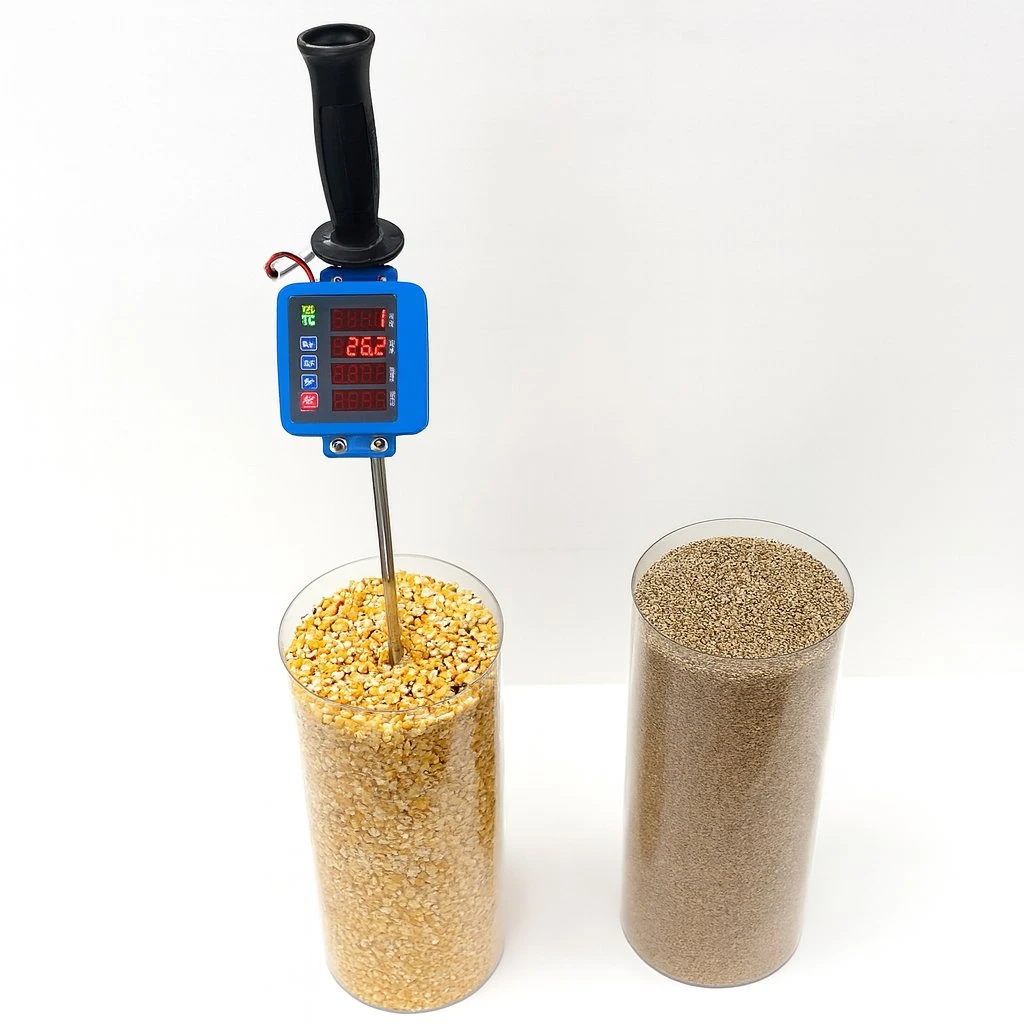
Although automated monitoring systems provide continuous and comprehensive temperature data, manual temperature probe rods still serve a practical role in modern storage management.
Probe rods are mainly used for quick spot checks and on-site verification. They offer immediate readings at specific locations, are simple to operate, and require no permanent installation or power supply. This makes them particularly useful during system maintenance, inspections, or in small and temporary storage setups where full automation may not be justified.
However, probe rods provide only isolated, momentary measurements and cannot reveal hidden hot spots or temperature trends in large or complex storage environments. As a result, manual probing is best used as a supplementary tool rather than a replacement for automated, multi-point monitoring systems.
6. How Automated Monitoring Supports Preventive Management
Automated monitoring allows managers to adopt a preventive approach instead of a reactive one:
- Early Warning:
Detect subtle temperature increases before visible deterioration emerges.
- Informed Decisions:
Continuous data supports ventilation strategies, aeration planning, and harvest scheduling.
- Risk Mitigation:
Rapid identification of hot spots helps prevent grain spoilage and financial loss.
These concepts tie directly back to the systemic understanding developed in the core pillar article,
👉 Grain Temperature Monitoring: The Cornerstone of Safe, Efficient, and Modern Grain Storage -
which emphasizes the importance of using data as the foundation of modern grain condition management.
7. Case Examples and Practical Scenarios
7.1 Scenario: Large High‑Bay Warehouse
In a high‑bay flat warehouse, a temperature increase of 2–3°C deep within the grain may go unnoticed for weeks through manual measurement. Automated systems, however, can identify such changes early, enabling ventilation adjustments that prevent mold growth.
This example links with insights from the second cluster article:
🔗 Warehouse Types and the Challenges of Grain Temperature Monitoring
7.2 Scenario: Seasonal Temperature Shifts
During seasonal transitions, grain temperature trends may vary significantly. Manual checks might miss critical inflection points. Continuous automated data gives operators a clear view of temperature trends, supporting better aeration decisions.
This reinforces understanding from the first cluster article:
🔗 Understanding Grain Temperature: Why It Is the Most Critical Indicator of Grain Condition

8. Conclusion: The Future of Grain Temperature Monitoring
As modern grain storage continues to scale and diversify, automated monitoring systems will play an increasingly important role. They not only provide real‑time visibility into internal temperature conditions but also support data‑driven management practices that enhance safety, efficiency, and grain quality preservation.
Manual measurement still has a place - especially as a supplementary tool - but it cannot replace the comprehensive capabilities of automated systems in large‑scale storage operations.
To fully understand how temperature monitoring systems are implemented at a structural and operational level, you can refer to the core pillar article here:
👉 Grain Temperature Monitoring: The Cornerstone of Safe, Efficient, and Modern Grain Storage