

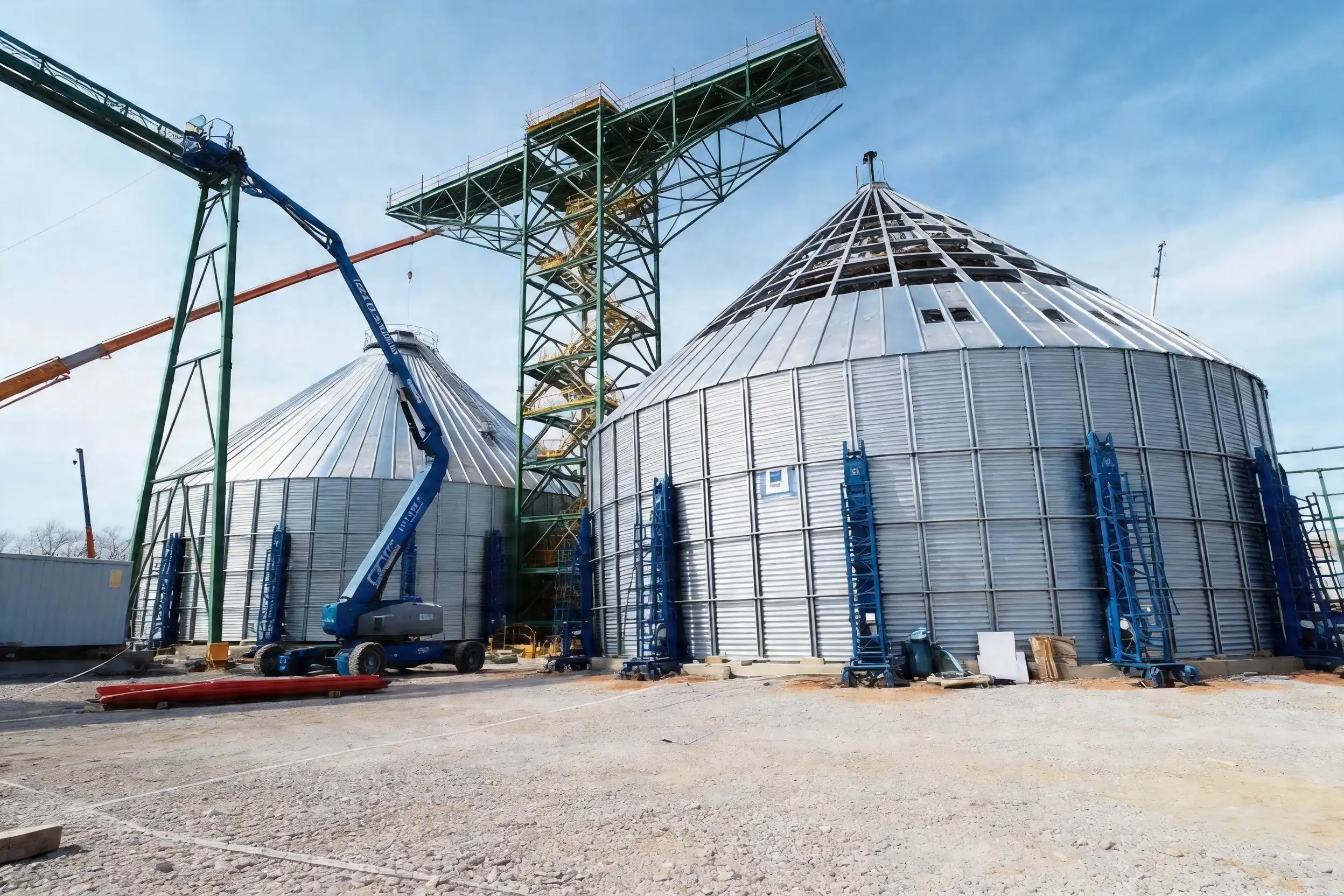
Biomass Storage Is More Than Just Filling a Silo
Wood pellets, wood chips, agricultural residues and other biomass fuels are increasingly stored in large silos before being transported, processed or burned in biomass power plants.
At first glance, the storage process appears relatively simple.
The material enters the silo, remains there for a period of time, and is discharged when required.
However, conditions inside a large biomass mass can change continuously.
Oxidation, moisture conditions, biological activity and heat accumulation may cause certain areas to become warmer than the surrounding material.
Research organizations studying biomass storage have shown that when internally generated heat exceeds the rate at which heat can dissipate, self-heating can become increasingly serious.
That is why modern biomass storage increasingly relies on more than a single thermometer.
Quick Overview
| Monitoring Item | What It Shows | Typical Technology |
|---|---|---|
| Internal material temperature | Temperature at different depths | Multi-point temperature cable |
| Surface temperature | Visible hot areas | Thermal imaging camera |
| CO | Possible combustion-related changes | Gas monitor |
| CO₂ / O₂ | Storage atmosphere condition | Gas sensors |
| Humidity | Environmental/storage condition | RH sensor |
| Level | Amount of material in silo | Radar / level sensor |
| Historical trend | Whether conditions are changing | RTU + software/cloud |
| Alarm | Abnormal conditions | PLC / RTU / monitoring platform |
The strongest monitoring systems do not rely on only one parameter.
Instead, they combine several types of information to give operators a clearer picture of what is happening inside the silo.
Why Is Internal Temperature Monitoring Important?
One of the biggest challenges with biomass storage is that an abnormal condition can develop inside the material.
The outside wall of a silo may still look normal.
The surface of the stored biomass may also appear normal.
But several meters below the surface, one area may already be warmer than its surroundings.
This creates a monitoring blind spot.
A temperature cable helps reduce that blind spot by placing several temperature sensors vertically inside the stored material.
For example:
| Silo Depth | Sensor Reading |
|---|---|
| Upper layer | 25.8°C |
| Upper-middle layer | 27.1°C |
| Middle layer | 31.6°C |
| Lower-middle layer | 38.4°C |
| Lower layer | 29.2°C |
In this example, simply knowing the average silo temperature would hide the unusual condition in the lower-middle section.
A multi-point system makes the temperature distribution much easier to identify.
A Temperature Cable Creates a Vertical Temperature Profile
The image above illustrates the general principle used in silo monitoring: sensors are distributed vertically inside the stored material instead of measuring only one location.
A simplified biomass silo installation may look like this:
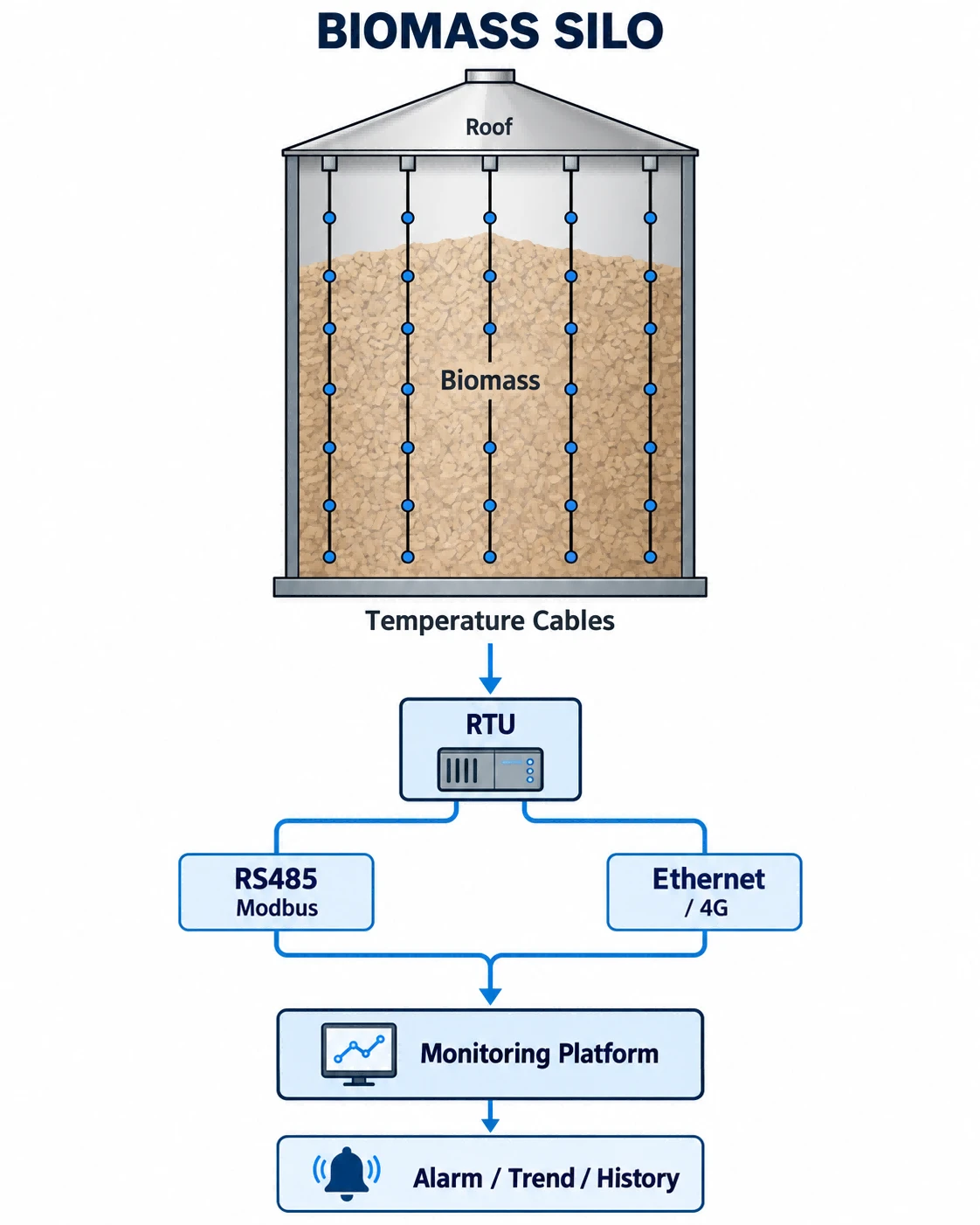
This architecture is already familiar in grain silos, feed silos and other bulk-storage facilities.
The major difference is that biomass applications may require different temperature ranges, mechanical protection and safety considerations.
Why Surface Thermal Imaging Alone May Not Be Enough
Thermal imaging is extremely useful.
A thermal camera can monitor a large area without contacting the material and quickly identify abnormal surface temperatures.
But there is an important limitation:
A thermal camera sees the surface. A temperature cable measures inside the material.
CHINO's biomass power-plant monitoring guidance, updated on August 24, 2026, specifically describes a monitoring architecture combining fixed thermal imaging with internal silo temperature-measuring cables. The company notes that thermal imaging is suited to surface temperature distribution, while internal temperature cables can monitor multiple points inside a silo.
CHINO – Fire Risk and Temperature Monitoring at Biomass Power Plants
So these technologies should not necessarily be treated as competitors.
A more complete system can use both.
| Technology | Best At | Limitation |
|---|---|---|
| Thermal camera | Large-area surface scanning | Cannot directly measure deep internal material |
| Temperature cable | Internal temperature profile | Measures only around installed sensor positions |
| CO monitoring | Combustion-related warning | Does not show exact internal temperature distribution |
| CO₂/O₂ monitoring | Atmosphere condition | Requires correct sensor placement and interpretation |
| RTU / software | Data analysis and alarms | Depends on reliable sensor inputs |
Temperature + Gas Monitoring Can Provide More Information
Temperature is only one part of biomass storage monitoring.
Coal and biomass storage systems also commonly monitor gases.
AMETEK Land, for example, identifies carbon monoxide monitoring as an important part of detecting potentially dangerous conditions in coal and biomass storage silos. Its guidance describes CO accumulation as an early indication associated with combustion processes and recommends combining monitoring with alarm/control systems.
AMETEK Land – Biomass / Coal Storage Silo Monitoring
A more advanced monitoring architecture could therefore look like this:
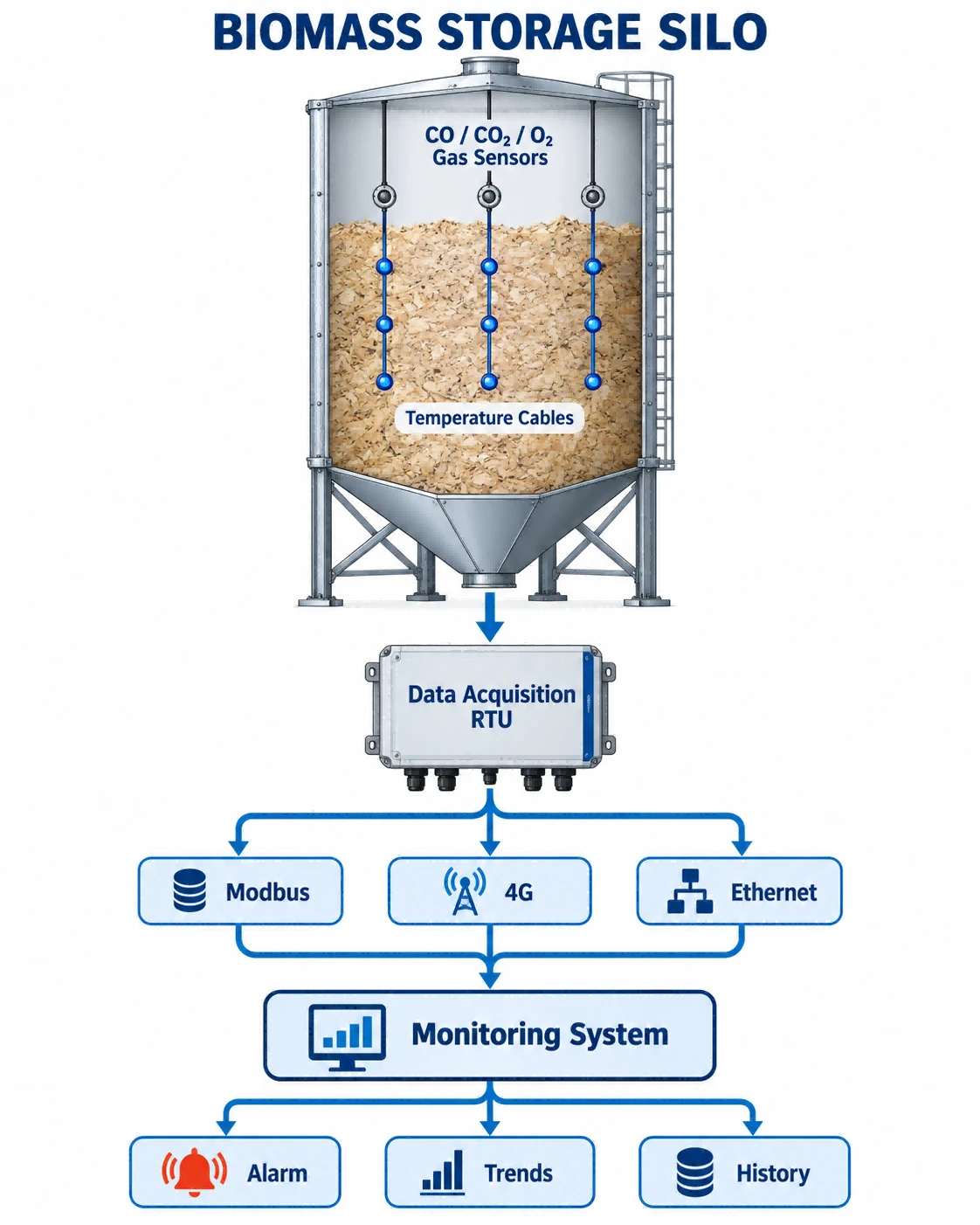
This is much closer to the direction modern industrial monitoring systems are moving toward.
Temperature Trend Can Matter More Than One Temperature Value
Imagine two sensors.
| Sensor | 08:00 | 12:00 | 16:00 | Change |
|---|---|---|---|---|
| Sensor A | 27.0°C | 27.3°C | 27.5°C | +0.5°C |
| Sensor B | 27.1°C | 30.8°C | 35.6°C | +8.5°C |
Neither sensor may yet have reached a very high absolute alarm threshold.
But Sensor B is behaving very differently.
This is why a good biomass silo monitoring system should not only ask:
Is the temperature too high?
It should also ask:
How quickly is the temperature changing?
A practical monitoring platform can evaluate:
Current temperature → maximum temperature → minimum temperature → rate of rise → sensor-to-sensor difference → historical trend.
CHINO's current biomass-monitoring architecture also includes alarms and historical data management rather than treating each temperature as an isolated reading.
How Many Temperature Cables Should a Biomass Silo Use?
There is no universal answer.
A 5-meter-diameter silo and a 30-meter-diameter silo obviously should not use the same sensor layout.
The design normally depends on several factors:
| Design Factor | Why It Matters |
|---|---|
| Silo diameter | Determines horizontal monitoring coverage |
| Silo height | Determines cable length and vertical sensor count |
| Biomass type | Different materials have different storage characteristics |
| Storage duration | Longer storage may require closer monitoring |
| Filling method | Can influence cable loading and material distribution |
| Discharge method | Affects mechanical forces on cables |
| Temperature range | Determines sensor and cable specification |
| Required alarm resolution | Influences sensor spacing |
| Hazardous-area classification | May affect sensor/electrical design |
Rather than asking only:
"How many sensors should one cable have?"
a better engineering question is:
"How much stored material is represented by each measurement point?"
Grain vs Feed vs Biomass vs Coal Temperature Monitoring
This comparison is useful because the same basic multi-point temperature technology can serve several industries.
| Application | Main Monitoring Concern | Typical Cable Requirement | Additional Sensors |
|---|---|---|---|
| Grain silo | Spoilage, insects, heating | Long cable, high tensile strength, food-storage suitability | RH / grain moisture |
| Feed silo | Heating, moisture, product quality | Multi-point temperature, abrasion resistance | RH / CO₂ |
| Biomass silo | Self-heating, hot spots | Higher temperature capability, strong mechanical design | CO / CO₂ / O₂ |
| Wood pellet silo | Heating + gas accumulation | Internal temperature profile | CO / O₂ |
| Coal silo | Oxidation and spontaneous heating | High strength, high-temperature capability | CO / thermal imaging |
| RDF silo | Variable material and fire risk | Heavy-duty construction | Gas / thermal imaging |
This also explains why a product originally developed for grain storage can inspire designs for other bulk materials-but should not simply be renamed without verifying whether the construction and certification suit the new application.
Wood Pellet Storage Has Another Important Risk: Carbon Monoxide
There is another reason gas monitoring matters.
Wood pellets can release carbon monoxide during storage even when no visible fire is present.
The UK Health and Safety Executive has issued specific guidance concerning carbon monoxide accumulation and oxygen depletion in enclosed wood-pellet storage spaces.
The guidance warns against entering pellet storage areas without appropriate confined-space procedures, ventilation and atmospheric testing.
UK HSE – Risk of Carbon Monoxide Release During Wood Pellet Storage
This distinction is important:
Material temperature monitoring is not the same as personnel gas-safety monitoring.
Both may be required in the same facility, but they solve different problems.
Frequently Asked Questions
What is a biomass silo temperature cable?
It is a cable assembly containing multiple temperature measurement points positioned along its length. The cable is suspended inside a silo so temperatures can be measured at different depths in the stored biomass.
Why use several temperature sensors instead of one?
A large silo does not have a perfectly uniform temperature. Multiple sensors make it possible to identify differences between layers and detect localized abnormal temperature trends.
Can a grain temperature cable be used in a biomass silo?
Possibly, but suitability must be verified. Biomass applications may have different requirements for operating temperature, tensile strength, abrasion resistance, fire safety and hazardous-area compliance.
Can temperature monitoring detect biomass self-heating?
It can detect temperature changes at the installed sensor locations and therefore help operators identify abnormal heating trends. It should be used together with appropriate storage-management and safety procedures.
Is a thermal camera better than a temperature cable?
They serve different purposes. Thermal imaging provides broad surface monitoring, while a temperature cable provides measurements inside the bulk material.
Should biomass silos also monitor CO?
CO monitoring is widely used in coal and biomass storage applications as another indication of changing combustion conditions. The appropriate sensor system depends on the facility and risk assessment. Ametek Land
Can the data be uploaded to a cloud platform?
Yes. A suitable RTU or gateway can collect temperature data and transmit it through RS485, Ethernet, 4G or other industrial communication networks.