

Why Does Grain Heat Up During Storage?
Grain can heat up even when it is stored inside a closed silo or warehouse. Understanding the causes of temperature changes is essential for maintaining grain quality and reducing storage losses.
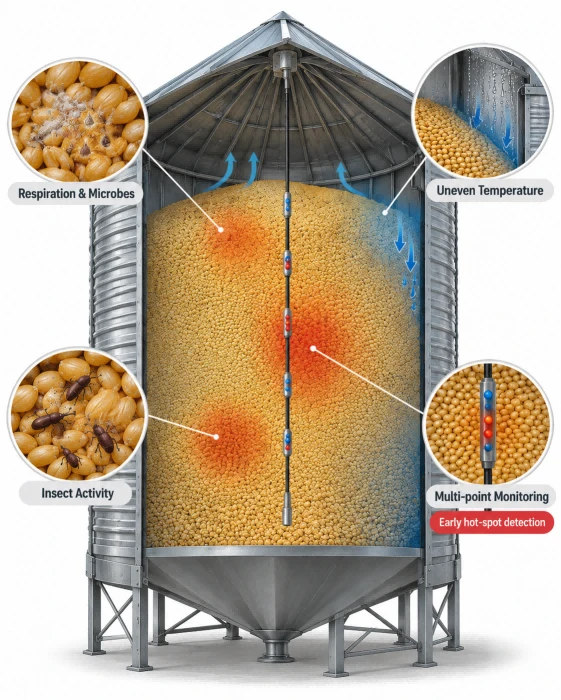
1. Respiration and Microbial Activity
Stored grain remains biologically active. Grain respiration produces heat, while fungi and other microorganisms may develop when moisture and temperature conditions are favorable.
If these conditions persist, localized heating and grain deterioration may occur.
2. Insect Activity
Insects can become active in warm stored grain. Their activity produces heat and may contribute to grain damage. Some insect infestations develop in localized areas before becoming obvious during routine inspections.
3. Uneven Temperature Distribution
Grain is a good natural insulator. Temperature differences between the center, surface, and walls of a storage bin can create internal air currents. These currents may move moisture toward cooler areas, increasing the risk of condensation and spoilage.
4. Why Temperature Monitoring Matters
Regular temperature measurements help operators identify unusual changes and determine where further inspection may be necessary.
Multi-point temperature monitoring cables measure grain temperatures at different depths and locations. Comparing readings over time helps operators identify developing hot spots that may not be apparent from a single measurement.
Maintaining grain quality requires appropriate moisture management, temperature control, regular inspection, and suitable aeration practices. Continuous or scheduled temperature monitoring provides valuable information for making timely storage-management decisions.
How Does Moisture Affect Grain Storage?
Moisture is one of the most important factors affecting stored grain quality. Even when grain appears dry on the surface, moisture can vary throughout a storage bin.

1. High Moisture Increases Storage Risks
When grain moisture is too high for the intended storage conditions, the risk of microbial growth, heating, and spoilage increases.
The appropriate moisture level depends on the grain type, storage temperature, and expected storage duration. Different crops require different storage conditions.
2. Moisture Can Move Inside a Grain Bulk
Temperature differences within a silo can create convection currents. Warm air may carry moisture toward cooler grain near the surface or roof, where condensation can occur.
This process can create localized wet areas even when the average moisture content of the stored grain appears acceptable.
3. Why Mold Can Develop
Warm and moist conditions can favor mold growth. If moisture accumulates in localized areas, grain quality may deteriorate before the problem becomes visible throughout the storage bin.
Operators should investigate unusual temperature changes, condensation, musty odors, and signs of grain caking.
4. How to Reduce Moisture-Related Risks
- Check grain moisture before storage.
- Inspect stored grain regularly.
- Monitor temperature changes at multiple locations.
- Evaluate outside air conditions before operating aeration fans.
- Investigate abnormal readings and visible signs of deterioration promptly.
Temperature monitoring and moisture testing provide complementary information. Neither measurement alone can fully determine grain condition, but together they help support more informed storage management.
How Multi-Point Temperature Monitoring Helps Protect Stored Grain
Temperature is an important indicator of stored grain conditions. However, a single measurement cannot show what is happening throughout a large grain bulk.
Multi-point temperature monitoring provides a more detailed view of temperature distribution inside silos and grain warehouses.

1. Monitor Different Depths
Temperature sensing cables can be installed vertically inside a grain bulk. Multiple sensing points measure temperatures at different depths, helping operators understand how conditions vary throughout the stored grain.
2. Identify Localized Temperature Changes
A localized temperature increase may be associated with insect activity, microbial growth, moisture accumulation, or other storage conditions.
Comparing measurements from neighboring points and reviewing historical data can help identify areas that require further inspection.
3. Support Better Aeration Decisions
Temperature data can help operators evaluate when additional inspection or cooling may be necessary. Aeration decisions should also consider outside air temperature, humidity, grain moisture, and the characteristics of the storage facility.
Temperature monitoring supports these decisions but does not replace proper grain inspection or moisture testing.
4. Improve Storage Management
When connected to a compatible data acquisition system, temperature sensing cables can provide centralized readings for multiple measurement points.
Depending on the system configuration, operators may review data through computer software or remote monitoring platforms. Alarm functions can also be configured to identify readings that exceed defined limits.
Multi-point temperature monitoring helps operators understand temperature variations inside stored grain and respond to potential problems more efficiently. Combined with moisture testing, regular inspections, and appropriate aeration, it supports a more proactive approach to grain storage management.