

Grain storage is more than simply keeping harvested grain in a warehouse or silo. During long-term storage, grain quality can be affected by moisture, insects, microorganisms, and changes in environmental conditions. These factors may cause temperature variations within the grain mass, sometimes leading to localized heating, mold growth, and grain deterioration.
One of the challenges in grain storage management is that problems inside a grain pile are not always visible from the outside. The temperature of the warehouse air may appear normal, while certain areas deep inside the grain are already experiencing unusual temperature changes.
This is why temperature monitoring cables play an important role in modern grain storage. Installed inside silos or grain warehouses, these cables measure temperatures at multiple points and different depths, helping operators understand the actual temperature conditions within stored grain.
By combining temperature monitoring cables with data loggers and remote monitoring platforms, grain storage facilities can improve monitoring efficiency, identify potential problems earlier, and make better storage management decisions.
1. Why Is Monitoring the Temperature Inside Grain Important?
Stored grain is not completely inactive. Grain respiration, insect activity, and microbial growth can all contribute to heat generation under suitable conditions. High moisture content and unfavorable storage conditions may further increase the risk of localized heating and deterioration.
Grain also has relatively low thermal conductivity. Heat generated within a grain pile may not dissipate quickly, allowing temperature differences to develop between the center, surface, and surrounding areas.
As a result, checking only the air temperature inside a storage facility is not enough to understand the condition of the entire grain mass.
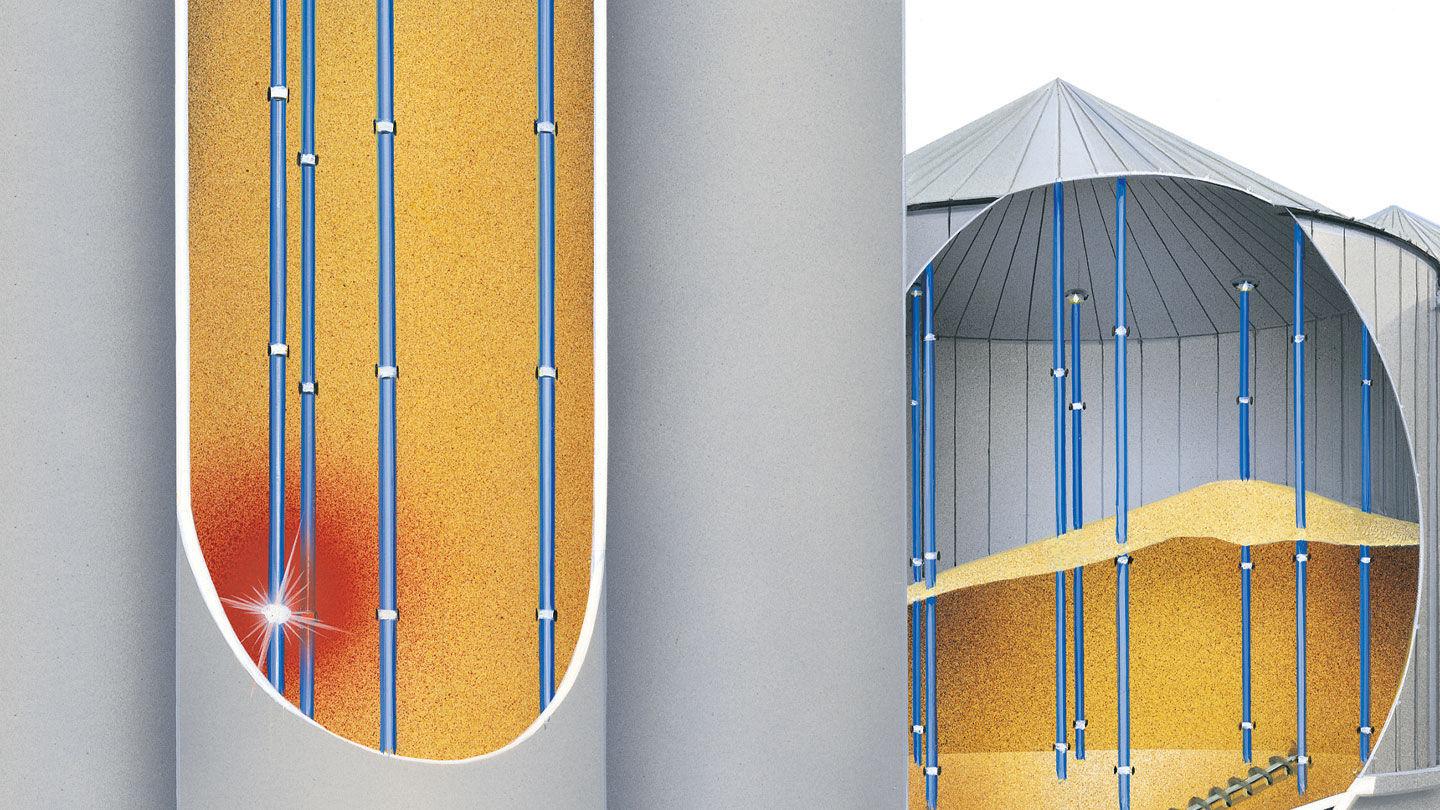
How temperature monitoring cables help:
Temperature monitoring cables are installed vertically from the roof of a silo or warehouse and extend into the grain. Multiple sensors are distributed along each cable, measuring temperatures at different depths.
This arrangement provides more detailed information about internal grain conditions than monitoring the surrounding air alone. Operators can identify temperature differences between measurement points and investigate areas that show unusual changes.
2. Multi-Point Monitoring Helps Reduce Temperature Blind Spots
The temperature of stored grain is not always uniform. Differences may occur between the upper, middle, and lower sections of a grain pile.
Temperature conditions near the walls and center of a silo may also vary due to environmental influences and grain movement.
Traditional manual temperature measurements are often limited by the number of accessible measurement locations and the frequency of inspection. It can be difficult to obtain a complete picture of temperature distribution throughout a large storage facility.
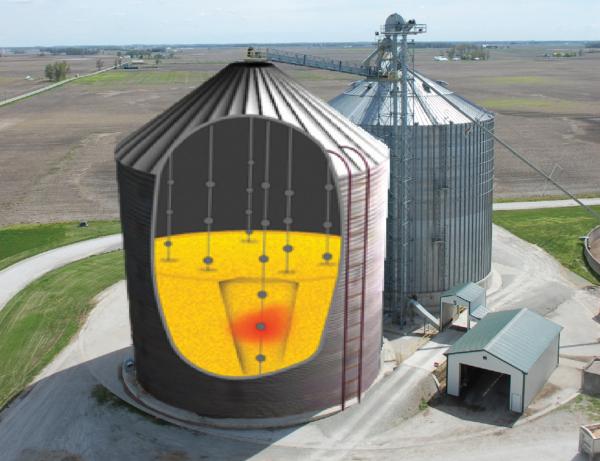
How temperature monitoring cables help:
A multi-point temperature cable contains several sensing elements positioned at different intervals along its length. Each sensor measures the temperature at a specific depth.
By installing multiple cables at suitable positions, operators can monitor different areas of a silo or warehouse.
This configuration offers several advantages:
Measures grain temperature at multiple depths
Provides temperature information from different areas of the storage facility
Helps identify temperature differences within the grain mass
Reduces dependence on individual manual measurement points
Supports more comprehensive grain condition monitoring
The number and arrangement of cables should be selected according to the silo dimensions, grain depth, storage conditions, and monitoring requirements.
3. Continuous Monitoring Helps Identify Unusual Temperature Changes
Grain heating does not always happen suddenly. In some situations, temperature changes develop gradually over time. If inspections are performed only occasionally, early signs of abnormal heating may be missed.
A single temperature reading provides limited information. Comparing readings over time is often more useful because it helps operators understand whether temperatures are stable, rising, or changing differently between measurement locations.
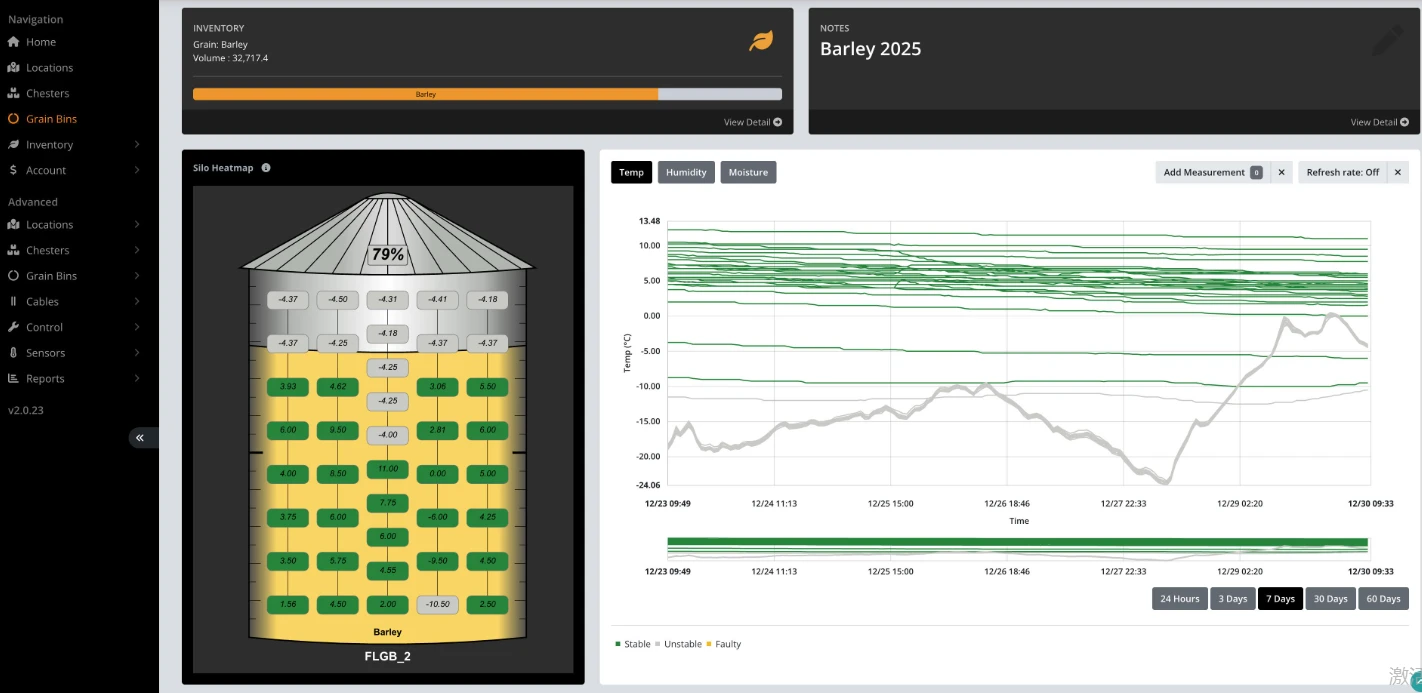
How temperature monitoring cables help:
When connected to a temperature data logger, monitoring cables can provide regular automatic temperature readings without requiring an operator to measure every point manually.
The collected data can be stored and displayed through monitoring software. Operators can review current temperatures, compare historical records, and observe changes at individual measurement points.
When the system is configured with suitable alarm thresholds, unusual temperature readings can trigger alerts, allowing operators to investigate potential problems promptly.
This combination of multi-point measurement and historical temperature analysis provides a more reliable basis for identifying possible grain storage risks.
4. Reduce Manual Inspections and Improve Management Efficiency
Large grain storage facilities may contain several silos or warehouses, each storing substantial quantities of grain. Manually checking temperature at different locations can require considerable time and labor.
As the number of storage facilities increases, maintaining consistent inspection schedules becomes more challenging.
How temperature monitoring cables help:
A centralized temperature monitoring system allows operators to collect temperature information from multiple cables and storage locations through connected data loggers.
Instead of visiting each measurement point, operators can view temperature readings through a computer or mobile monitoring platform.
The system can provide:
- Centralized temperature monitoring for multiple storage facilities.
- Automatic collection of temperature data.
- Historical temperature records for comparison.
- Convenient identification of abnormal measurement points.
- Remote access to monitoring information, subject to network availability.
This approach reduces repetitive manual measurement work and makes daily grain storage management more efficient.
5. Temperature Data Supports Better Ventilation Decisions
Ventilation is an important part of grain storage management. Properly planned ventilation can help reduce grain temperature and improve storage conditions.
However, ventilation should not be performed simply because the outside air feels cool. Air temperature, relative humidity, dew point, grain temperature, and the moisture condition of the stored grain all need to be considered.
Unsuitable ventilation conditions may introduce additional moisture into the grain or cause condensation in certain areas.
How temperature monitoring cables help:
Temperature monitoring cables provide information about temperature conditions at different depths inside the grain pile.
By comparing temperature readings before, during, and after ventilation, operators can evaluate cooling performance and understand how temperatures change throughout the grain mass.
When combined with ambient temperature and humidity sensors, ventilation control equipment, and monitoring software, the system can provide useful data for automated or semi-automated ventilation management.
Temperature monitoring does not replace professional ventilation decisions, but it provides an important reference for making them.
6. Temperature Monitoring Cables vs. Traditional Manual Measurement
Both manual measurement and automated monitoring can be used in grain storage. However, they differ in measurement coverage, data collection, and management efficiency.
| Comparison | Traditional Manual Measurement | Multi-Point Temperature Cable System |
|---|---|---|
| Measurement depth | Depends on manual access | Measures at different depths |
| Monitoring coverage | Limited by inspection locations | Multiple cables cover different areas |
| Data collection | Periodic manual readings | Automatic scheduled readings |
| Historical records | Manual recording | Automatic data storage |
| Temperature analysis | Depends on manual comparison | Supports historical trend analysis |
| Abnormal temperature alerts | Requires manual observation | Configurable automatic alarms |
| Remote monitoring | Usually requires on-site inspection | Available through connected platforms |
| Management efficiency | More repetitive manual work | Reduces routine measurement tasks |
The main advantage of a multi-point temperature monitoring system is its ability to provide continuous access to temperature information from multiple locations, making grain storage management more systematic and data-driven.
7. What Should You Consider When Choosing a Grain Temperature Monitoring Cable?
Selecting a suitable temperature monitoring cable is important for long-term operation. Different grain storage facilities may have different installation environments, cable lengths, monitoring points, and mechanical requirements.
Several factors should be considered:
The cable should have sufficient mechanical strength to withstand the loads and operating conditions associated with installation inside grain storage facilities.
The number of temperature sensors and their spacing determine how many measurement points are available along each cable. These should be selected according to grain depth and monitoring requirements.
Reliable measurement accuracy is important when comparing temperature readings and identifying unusual changes over time.
The cable structure and protective materials should be suitable for the storage environment, including dust, humidity, temperature variations, and other site-specific conditions.
The monitoring cable should work with suitable temperature data loggers, communication interfaces, and monitoring software to support automatic data collection and centralized management.
8. Building a Smarter Grain Temperature Monitoring System
A modern grain temperature monitoring system usually consists of several connected components:
Temperature Monitoring Cables: Installed inside silos or warehouses to measure grain temperatures at multiple points.
Ambient Temperature and Humidity Sensors: Monitor environmental conditions outside or around the storage facility.
Temperature Data Logger: Collects measurement data from the monitoring cables.
Communication System: Transfers collected information to a monitoring platform through suitable communication interfaces.
Monitoring Software: Displays real-time readings, historical trends, and configured temperature alarms.
Ventilation Control Equipment: Works with monitoring information to support appropriate ventilation management.
When these components work together, operators can obtain a clearer understanding of grain storage conditions and manage multiple storage facilities more efficiently.
Previous article:Learn The Little-known Facts About Grain Storage