

Grain temperature monitoring is an important part of modern grain storage management. Inside a silo, temperature can vary at different depths and locations, and localized temperature increases may indicate moisture migration, biological activity, or developing spoilage.
A grain temperature monitoring cable provides a practical way to continuously measure temperature at multiple points inside stored grain and transmit the data to a monitoring system.
What Is a Grain Temperature Monitoring Cable?

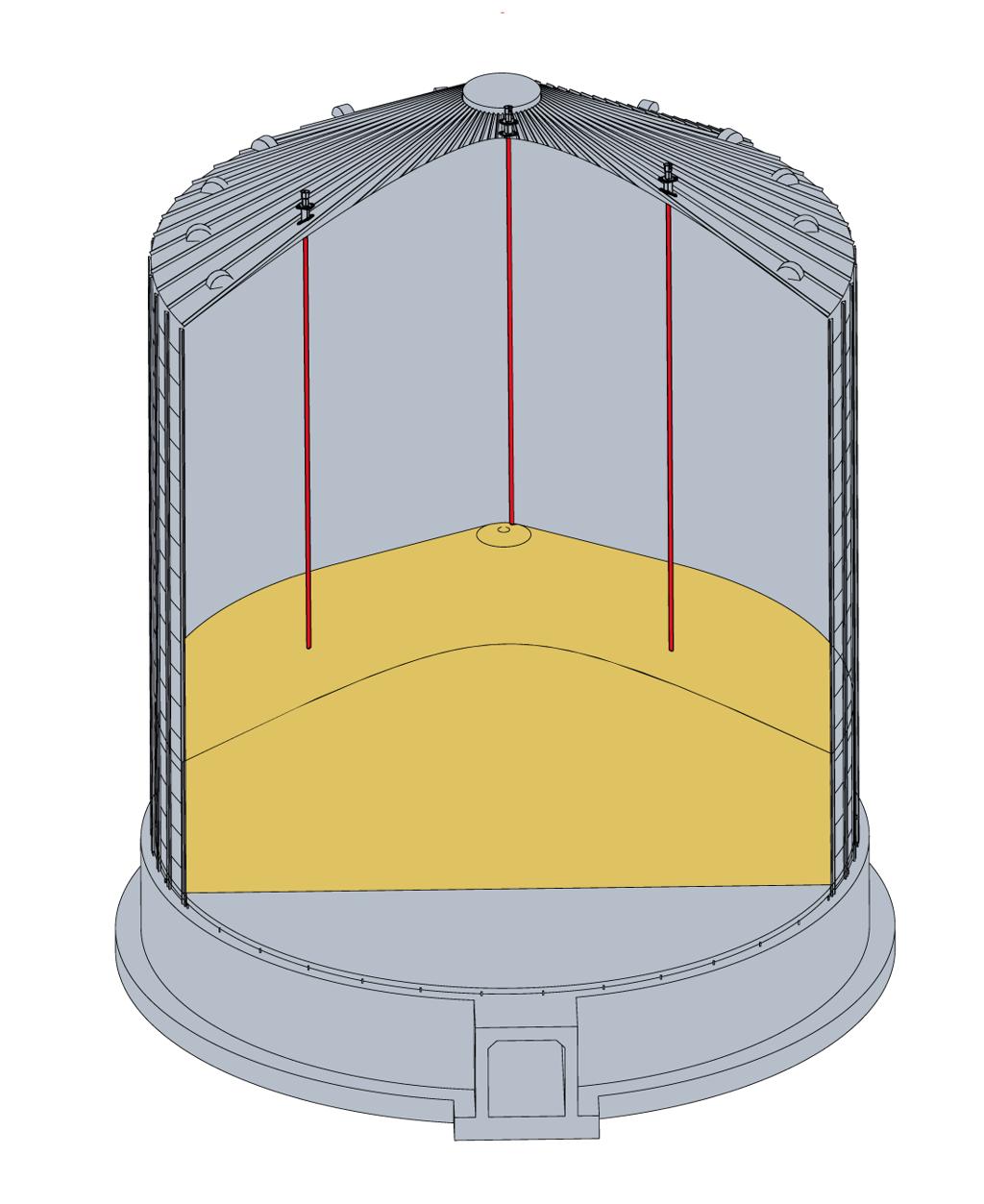
A grain temperature monitoring cable is a flexible cable assembly with multiple temperature sensors distributed along its length.
The cable is normally suspended vertically inside a grain silo. The sensors are positioned at different heights, allowing the system to measure temperature at different layers of the stored grain.
A typical system consists of:
| Component | Function |
|---|---|
| Temperature monitoring cable | Carries multiple temperature sensors |
| Temperature sensors | Measure temperature at individual points |
| Data acquisition unit | Reads and processes sensor data |
| RS485 / communication interface | Transfers measurement data |
| Monitoring software | Displays temperature data and alarms |
| Cloud platform | Enables remote monitoring and management |
The key advantage is that one cable can monitor multiple temperature points, rather than measuring only the temperature at the surface of the grain.
How Does a Temperature Cable Work Inside a Silo?
The basic working process can be divided into five steps.
1. The cable is installed inside the grain
The monitoring cable is vertically positioned inside the silo.
Depending on the silo structure and monitoring requirements, several cables may be installed at different locations.
For example:
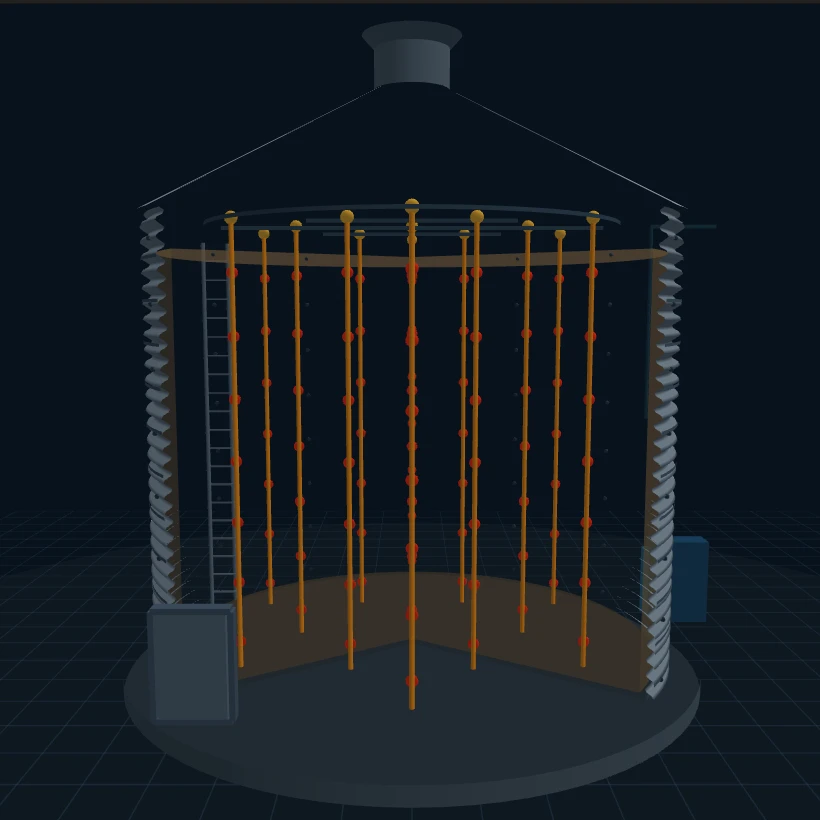
Each sensor represents a different measurement point.
This allows operators to understand the vertical temperature distribution inside the grain mass.
2. Sensors measure temperature at different depths
Temperature sensors are installed at predetermined intervals along the cable.
For example, a cable may contain sensors at:
- 1 m
- 2 m
- 3 m
- 4 m
- 5 m
The actual sensor spacing and number of measurement points can be customized according to the silo size and monitoring requirements.
Each sensor measures the temperature of the surrounding grain.
3. The acquisition unit reads the sensors

The temperature cable is connected to a data acquisition unit or RTU.
The acquisition unit sequentially reads each sensor and converts the sensor signal into a temperature value.
For a digital sensor system, the process can be represented as:
Temperature Sensor → Acquisition Unit → Digital Temperature Data
The acquisition unit can then associate each measurement with its corresponding cable and sensor position.
4. Temperature data is transmitted
After collecting the measurements, the acquisition unit can transmit the data through an industrial communication interface such as RS485/Modbus RTU.
For larger systems, the data can then be transferred through Ethernet, 4G, LoRa, or other communication methods to a monitoring platform.
A typical architecture is:
Temperature Sensors
1
>>
Monitoring Cable
2
>>
Data Acquisition Unit
3
>>
RS485 / Modbus
4
>>
Gateway / Communication Device
5
>>
Cloud Platform
6
This means operators do not necessarily need to enter the silo area to check temperature data.
5. The system identifies abnormal temperature changes
The monitoring software can display temperature values from individual sensors and compare measurements between different points.
For example:
| Cable | Point | Temperature | Status |
|---|---|---|---|
| Cable 1 | T01 | 22.4°C | Normal |
| Cable 1 | T02 | 22.8°C | Normal |
| Cable 1 | T03 | 23.1°C | Normal |
| Cable 1 | T04 | 29.6°C | Attention |
| Cable 1 | T05 | 23.0°C | Normal |
A significantly higher temperature at one point can indicate a potential localized problem.
The system can generate an alarm according to configured temperature thresholds or temperature-change rules.
Why Are Multiple Temperature Points Important?
Grain inside a silo does not necessarily have a uniform temperature.
Different areas may experience different conditions because of:
- Moisture migration
- Ambient temperature changes
- Grain respiration
- Microbial activity
- Uneven grain filling
- Poor aeration
- Condensation
- Localized heating
A single temperature sensor may not detect a localized hot spot.
Multiple sensors distributed vertically through the grain provide a more complete picture of the temperature profile.
For example, if most measurement points are around 22–24°C but one point gradually increases to 28–30°C, the monitoring system can highlight that location for further inspection.
How Many Temperature Cables Does a Silo Need?
There is no single number suitable for every silo.
The required number depends on factors such as:
- Silo diameter
- Silo height
- Grain type
- Storage capacity
- Cable measurement range
- Sensor spacing
- Monitoring accuracy requirements
- Applicable storage standards
For a larger silo, multiple cables can be distributed across the horizontal area.
Grain Temperature Monitoring Cable vs. Manual Measurement
| Feature | Temperature Cable | Manual Measurement |
|---|---|---|
| Measurement points | Multiple | Usually limited |
| Continuous monitoring | Yes | No |
| Remote monitoring | Possible | Usually no |
| Hot-spot detection | Yes | More difficult |
| Data recording | Automatic | Manual |
| Real-time alarm | Possible | Limited |
| Large silo application | Suitable | Less efficient |
For large-scale grain storage facilities, automated monitoring can significantly reduce the need for repeated manual measurements.
What Should You Consider When Choosing a Grain Temperature Cable?
When selecting a cable for silo applications, several technical specifications should be considered.
Number of measurement points:The cable should provide enough sensors for the required monitoring depth.
Temperature accuracy: For grain storage, sensor accuracy directly affects the reliability of temperature monitoring and alarm decisions.
Mechanical strength:The cable must withstand installation, grain pressure, pulling forces and long-term use inside the storage environment.
Environmental protection:Protection against moisture, dust and mechanical damage is important for long-term operation.
Sensor communication:Different temperature cables may use different sensor architectures and communication methods. Compatibility with the acquisition system should be confirmed before installation.
Communication protocol: For industrial systems, RS485 and Modbus RTU are commonly used between acquisition equipment and higher-level control or monitoring systems.
Installation method: The cable structure should be suitable for the silo type, installation height and expected grain movement.
Conclusion
A grain temperature monitoring cable works by placing multiple temperature sensors at different positions inside a silo. The sensors continuously measure the temperature of the surrounding grain, while an acquisition unit collects and transmits the data to a monitoring system.
The basic principle is simple:
Multiple Sensors → Temperature Cable → Data Acquisition → Communication → Monitoring Platform → Alarm
The value of the system comes from its ability to show where temperature changes occur, not simply whether the overall silo temperature is high.
For grain storage facilities, correctly designed temperature monitoring can therefore become an important part of preventive storage management.
ZSTC Temperature Cable & Grain Monitoring Solutions