

In fact, almost all conditions harmful to stored products tend to worsen as temperature rises - such as increased moisture, mold, and fungal growth.
Therefore, accurately monitoring and regulating silo temperature is critical for extending storage life, preserving grain quality, and preventing economic losses or safety risks.
Higher temperatures accelerate the grain's natural respiration, leading to moisture release and elevated local humidity, which creates ideal conditions for mold and fungi.
Mold and fungi thrive in warm, humid environments, causing grain spoilage and potentially producing harmful substances like aflatoxins.
Insect activity is also closely tied to temperature-the warmer it gets, the faster pests reproduce and the greater the damage.
Moisture migration, often caused by temperature differences, can lead to condensation and the formation of "hot spots," resulting in localized spoilage that spreads over time.
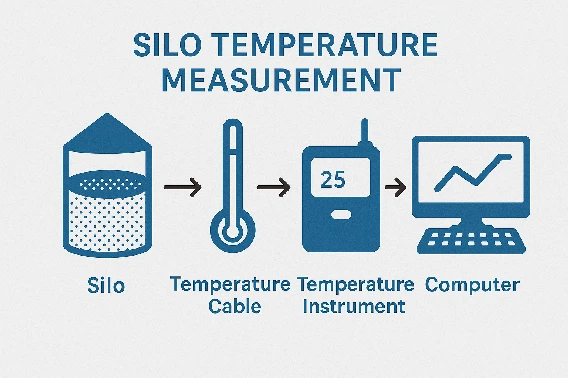
Silo
Used for storing grain; it is the object being monitored for temperature.
Temperature Cable
Installed inside the silo to collect temperature data at different depths.
Temperature Instrument
Connects to the temperature cable and displays real-time temperature readings.
Computer
Receives data from the temperature instrument for recording, analysis, and trend monitoring

To ensure the safe storage of grain and prevent issues such as mold and spontaneous heating, temperature monitoring inside silos is critically important. The silo temperature monitoring system uses specialized grain temperature monitoring cables to achieve comprehensive and real-time surveillance of the storage environment.
First, temperature monitoring cables with replaceable sensor cores are installed at key points inside the silo. These cables contain high-precision sensors embedded at multiple levels to accurately detect the temperature within the grain mass. The sensors are highly responsive, accurate, and resistant to interference, ensuring reliable data collection.
Next, the collected temperature signals are transmitted to a PLC or an automated monitoring system for integration and analysis. By setting threshold values for temperature or humidity, the system can automatically determine whether the current storage conditions are within a safe range.
During monitoring, if the system detects an abnormal temperature rise-such as a localized hotspot in the grain-it will automatically trigger an alarm to alert management personnel for timely intervention. The alerts can be displayed on local terminals or uploaded to a cloud platform for remote, multi-site supervision.
Additionally, the system supports easy replacement of individual sensor cores without the need to dismantle the entire cable, significantly saving time and maintenance costs.
Through this complete workflow, the silo temperature monitoring system provides strong protection for grain storage safety and has become an essential component of modern grain warehouse management.